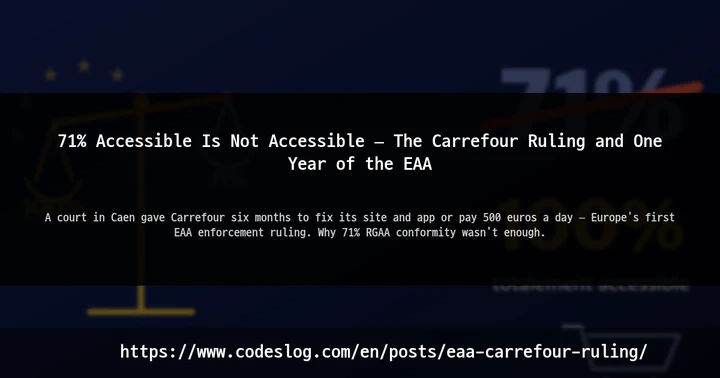
Imagine scoring 71 on a test. Not quite “well done,” but surely enough to say “you tried,” right?
Carrefour, one of France’s largest retailers, seems to have thought so too. In court, the company argued: “Our website complies with 71% of the French accessibility standard.”
The court’s answer was blunt.
“An e-commerce site cannot be only somewhat accessible; it must be totally accessible.”
On June 4, 2026, the judicial court of Caen, France, ordered Carrefour to make its website and mobile app fully accessible within six months. Miss the deadline, and a penalty of 500 euros accrues every single day. It’s the first enforcement ruling to come out of the European Accessibility Act (EAA) regime.
Let’s look at why this ruling matters, what’s happening across Europe right now, and what it means for the rest of us.
The European Accessibility Act, in 3 Minutes#
First, some background — so this post stands on its own.
The European Accessibility Act (EAA) is the common name for EU Directive 2019/882. Adopted in 2019, it has applied across all member states since June 28, 2025. The core idea is simple:
People with disabilities must be able to use products and services on an equal basis with everyone else.
Its scope is broad. It covers services and products well beyond websites:
- E-commerce (online shops in general)
- Banking and financial services
- Transport and event ticketing (online and kiosks)
- Telecommunications services
- E-books and dedicated readers
- Video streaming services
The technical benchmark is the European harmonised standard EN 301 549, which for web content is essentially WCAG 2.1 AA.
There are a few important exemptions and transition periods:
- Microenterprise exemption: Service providers with fewer than 10 employees and annual turnover under 2 million euros are exempt.
- Legacy transition: Some services and products offered before June 28, 2025 have until June 28, 2030 to comply.
One thing worth highlighting: the EAA applies to companies outside the EU as well. No EU headquarters needed — if you serve EU consumers, you’re in scope. That includes companies in Korea, the US, or anywhere else.
What Happened to Carrefour#
This ruling didn’t come out of nowhere. There’s a year-long timeline behind it.
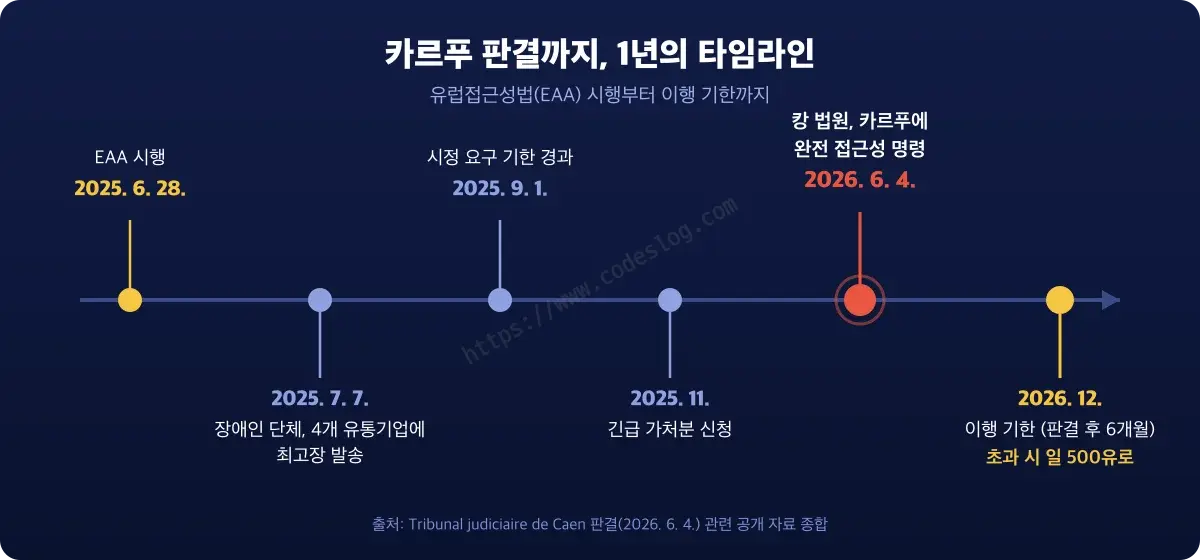
On July 7, 2025 — just ten days after the EAA took effect — French disability organizations made their move. apiDV, a support organization for people with visual impairments (the acronym stands for “accompany, promote, and integrate people with visual impairments”), and Droit Pluriel (literally “Plural Rights”), a disability rights organization, backed by the public-interest litigation group Intérêt à Agir, sent formal notices demanding accessibility compliance to four major retailers: Auchan, Carrefour, E.Leclerc, and Picard.
Fun fact: intérêt à agir is the French legal term for standing to sue — the right to bring a case to court. The group literally named itself “we have standing.” That’s commitment, starting from the naming stage.
When the responses to the September 1, 2025 deadline proved insufficient, the organizations filed for emergency injunctions in November 2025.
The results split. In May 2026, in the Auchan case, the court acknowledged non-compliance but declined emergency relief. Then on June 4, 2026, the judicial court of Caen (Tribunal judiciaire de Caen) reached a very different conclusion about Carrefour.
Here’s the ruling in summary:
| Item | Details |
|---|---|
| Scope | The carrefour.fr website and the mobile app |
| Order | Full accessibility within six months |
| Enforcement | A daily penalty (astreinte) of 500 euros after the deadline |
| Damages | Not awarded |
| Legal basis | Article L.412-13 of the French Consumer Code (transposing the EAA) |
Notably, the ruling skipped damages entirely and focused on one thing: “fix it.” The goal isn’t punishment — it’s producing an outcome.
Why “71% Compliant” Didn’t Hold Up in Court#
Carrefour’s defense was, honestly, fairly diligent:
- 71% conformity with RGAA, the French accessibility standard
- Steady year-over-year improvement
- An internal accessibility testing program involving testers with visual impairments
- A plan to reach 100% conformity by the end of 2026
RGAA (Référentiel Général d’Amélioration de l’Accessibilité, roughly “General Framework for Improving Accessibility”) is France’s national accessibility evaluation standard, based on WCAG 2.1 AA. By that measure, 71% is frankly better than many sites out there.
But the court acknowledged all of that effort — and didn’t budge on the conclusion. The core logic of the ruling comes down to one sentence:
Accessibility is an obligation of result (obligation de résultat), not an obligation of means (obligation de moyens).
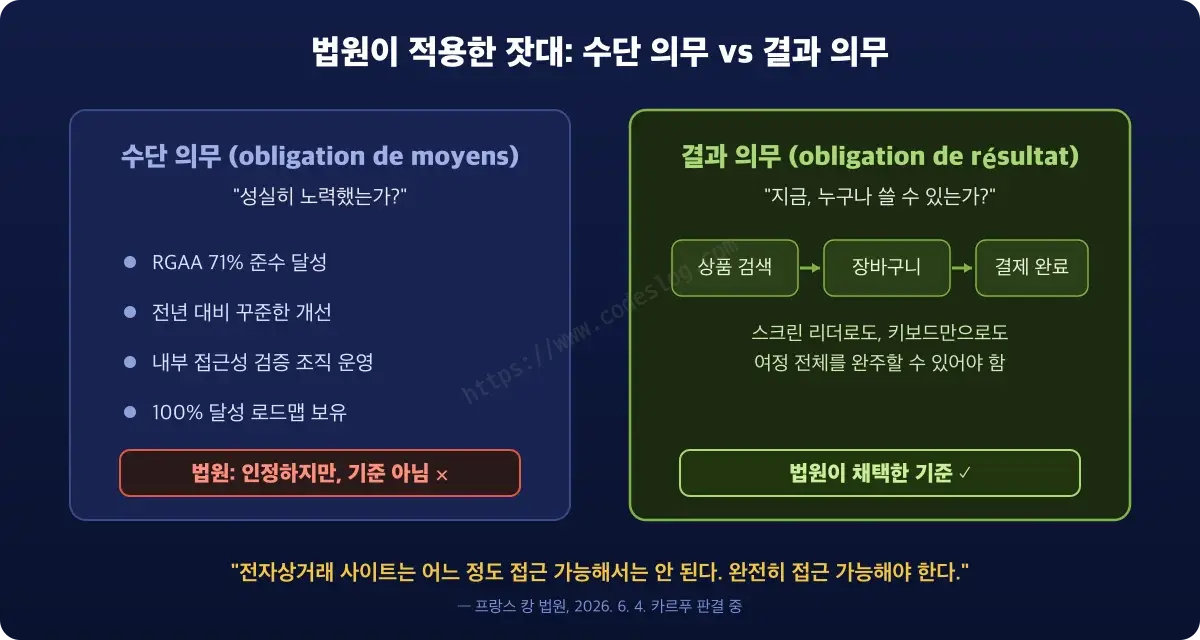
If the legal jargon feels foreign, here’s the plain version:
- Obligation of means: You’ve met your duty if you made a genuine effort toward the goal (think: a doctor’s treatment)
- Obligation of result: You’ve met your duty only if the promised outcome actually happens, effort aside (think: a package delivery)
The court put accessibility in the second category. “We’re working hard on it” isn’t an answer. The only question that counts is: “Can a person with a disability buy groceries on this site, today?”
A world where “but I had a plan” doesn’t count — sound familiar? It’s the last day of summer vacation, and the homework is due. Or, for developers: it’s the moment “it worked on my machine” meets a production outage.
For the record, here’s what this ruling established:
- The first EAA-regime ruling ordering remediation against a retailer
- The first case to explicitly include a mobile app in the order
- A clear precedent that partial conformity (71%) counts as non-compliance
The second point matters most in practice. Accessibility conversations have long been web-centric — now there’s case law confirming that apps sit on the same scale.
All of Europe Is Moving#
The Carrefour ruling is symbolic, but similar currents are running across Europe. One year into the EAA, here’s the enforcement picture:
- Germany: Right after the BFSG (Germany’s EAA transposition) took effect, law firms began sending warning letters (Abmahnungen) based on competition law. The private sector moved before regulators did.
- Sweden: The Post and Telecom Authority (PTS) opened its first cases against major e-commerce companies in October 2025. It has received 124 formal complaints.
- Netherlands: The consumer authority (ACM) has requested information from e-commerce operators worldwide — including companies outside the EU — with formal enforcement expected in the second half of 2026.
The penalty ceilings across member states are nothing to shrug at either:
| Country | Maximum penalty |
|---|---|
| Germany | Up to €100,000 per violation |
| Spain | Up to €1,000,000 |
| Italy | Up to €1,000,000 |
| Netherlands | Up to €900,000 or 10% of annual revenue |
| Ireland | Up to €60,000 plus potential criminal liability (up to 6 months) |
Meanwhile, across the Atlantic, the mood is different. In April 2026, the US Department of Justice extended the deadline for public entities’ web accessibility obligations under ADA Title II — to strong protest from disability advocates. While Europe steps on the accelerator, the US has a foot hovering over the brake.
Is This Just Someone Else’s Story?#
“What does a French supermarket have to do with me?” Fair question. But this fire is closer than it looks.
Just two months before the Carrefour ruling, in April 2026, South Korea’s Supreme Court finalized a strikingly similar verdict — capping a lawsuit that blind plaintiffs had pursued against Gmarket, E-mart (SSG.com), and Lotte Shopping for nearly a decade:
- An online mall’s failure to provide alt text for product images constitutes indirect discrimination under Korea’s Act on the Prohibition of Discrimination Against Persons with Disabilities
- Even for product listings uploaded by individual sellers, the platform operator bears the accessibility obligation
- Within six months of the ruling becoming final, shopping information must be made available via screen readers
Six months in France, six months in Korea. Two courts assigned the same homework with the same due date.
The differences are just as telling, though. Korea’s Supreme Court struck down the damages award (about 100,000 won per plaintiff), leaving a remediation order with no compensation — and no daily-penalty mechanism like France’s astreinte to back it up. That’s why the plaintiffs have now filed a constitutional complaint. Korea has reached the point of ordering fixes, but the answer to “what happens if they don’t?” remains weaker.
And there’s plenty to fix. In South Korea’s 2025 national web accessibility survey, the compliance rate for alternative text was just 17.1%. I covered that survey in detail in a previous post.
What We Developers Should Take Away#
Once you put the ruling down, one question remains for practitioners: “So what do I actually do?”
① Stop setting “partial compliance” as the goal
The lesson isn’t that 71% is a low number — it’s that accessibility isn’t a percentage problem. If a screen reader user makes it all the way to the cart but can’t press the checkout button, the service is 0% for that user, no matter how polished the other 99% is. Conformance rates are a management metric; user experience is evaluated journey by journey.
② Get one core user journey working end to end
You can’t make every page 100% accessible overnight. But you can start today by making one critical journey — “search → product page → cart → checkout” — fully completable with assistive technology. That’s what the court looked at, too: can this person do their shopping?
③ Hold apps to the same standard as the web
With a mobile app explicitly named in a court order, “we’ll do the app later” has become a risky prioritization. Check whether your accessibility review process actually includes your apps.
④ Remove blockers rather than documenting progress
Carrefour diligently documented its improvements and plans — and it didn’t matter against an obligation of result. Eliminating one real blocker is worth more, legally and to your users, than another roadmap document.
Wrapping Up#
One year of the European Accessibility Act can be summed up like this:
Accessibility has shifted from a recommendation to a debt.
We’ve moved from an era of proving effort to an era of verifying outcomes. And as Korea’s Supreme Court ruling shows, this current isn’t confined to Europe.
Think about that number, 71%, one more time. To a development team, it says “we’ve come a long way.” To a user sitting in front of a screen reader, it says “three out of ten times, I hit a wall.” The court ruled from the second seat.
Which seat will our services be judged from? I hope we can answer with our users’ completed journeys — not with a court ruling.
References#
- EAA Digital Accessibility Compliance: What the Carrefour Ruling Teaches Every Business (BarrierBreak)
- The Carrefour Ruling: A Court Orders Full App Accessibility (Auditsu)
- European Accessibility Act: First Court Ruling (LI Solutions)
- EAA Compliance in 2026: How Enforcement Has Evolved (Level Access)
- European Accessibility Act (EAA) Enforcement and Implementation (Law Office of Lainey Feingold)
- Supreme Court: “Online malls must provide image descriptions for blind users” (Newspim, Korean)
- DOJ Extends Web Accessibility Deadline (Inside Higher Ed)
Leave a comment