“Your project spec says ‘must comply with KWCAG 2.2.’ But what does that actually mean you have to do?”
If you’ve ever worked on an accessibility project in Korea, you’ve probably paused at a line like that at least once. Search around and you’ll find WCAG mentioned in one place, KWCAG in another, versions 2.1 and 2.2 tangled together — it’s easy to lose track of which standard you’re actually supposed to follow. This post breaks down what KWCAG 2.2 actually is and how it’s structured, from a practitioner’s point of view.
Why Does Korea Have Its Own Guidelines?#
When people think of accessibility standards, WCAG (Web Content Accessibility Guidelines) usually comes to mind first. It’s the W3C’s international standard, and most accessibility laws around the world reference it. But adopting an international standard as-is into domestic regulation runs into practical hurdles — turning it into a legal document requires going through a national standardization process, plus interpretation tailored to the local service environment. That’s why Korea’s National Radio Research Agency (RRA) built a set of guidelines on WCAG’s foundation, adapted to Korean conditions, and registered it as a national standard: KWCAG (Korean Web Content Accessibility Guidelines).
The important part is that KWCAG isn’t a straight “translation” of WCAG. Rather than pulling in every WCAG success criterion, it selected mostly the essential ones, based on their impact across Korean industry (more on this below, under “Not a Full Adoption”). If you assume “WCAG compliance = KWCAG compliance,” you might get an unpleasant surprise late in a project when the checklists don’t line up.
KWCAG’s Formal Name: KS X OT0003#
KWCAG 2.2’s official national standard designation is KS X OT0003:2022. It’s classified as a broadcasting and telecommunications standard, managed and issued by the National Radio Research Agency (RRA).
Search for the number and you’ll see two forms — KS X OT0003 and KS X OT0003:2022 — which makes you wonder which one is right. Both are. The year after the colon identifies the edition. The first is the standard’s permanent number, unchanged across revisions; the second pins down the 2022 edition specifically. The previous edition, KWCAG 2.1, is KS X OT0003:2015 by the same convention — the same practice as citing ISO 9241-11:2018.
So when it matters which edition you mean, adding the year is the safer choice. The date confusion below is exactly what happens when nobody pins the edition down.
The most confusing detail is the revision date. KWCAG 2.2 was revised and issued on December 28, 2022 — both the RRA’s official notice and press releases from the National Information Society Agency (NIA, 한국지능정보사회진흥원) use this date. Yet you’ll run into sources online that place the revision in 2023. It’s worth understanding why. A standard has a main text and a separate explanatory guide, and the guide comes out later than the text. Copy the guide’s publication date over as the standard’s revision date and the year slips by one.
They’re different documents. The standard changed on December 28, 2022; the guide is a companion published afterwards. When you’re establishing what you have to comply with, the main text is the one that counts.
The 4-Principle Structure, By the Numbers#
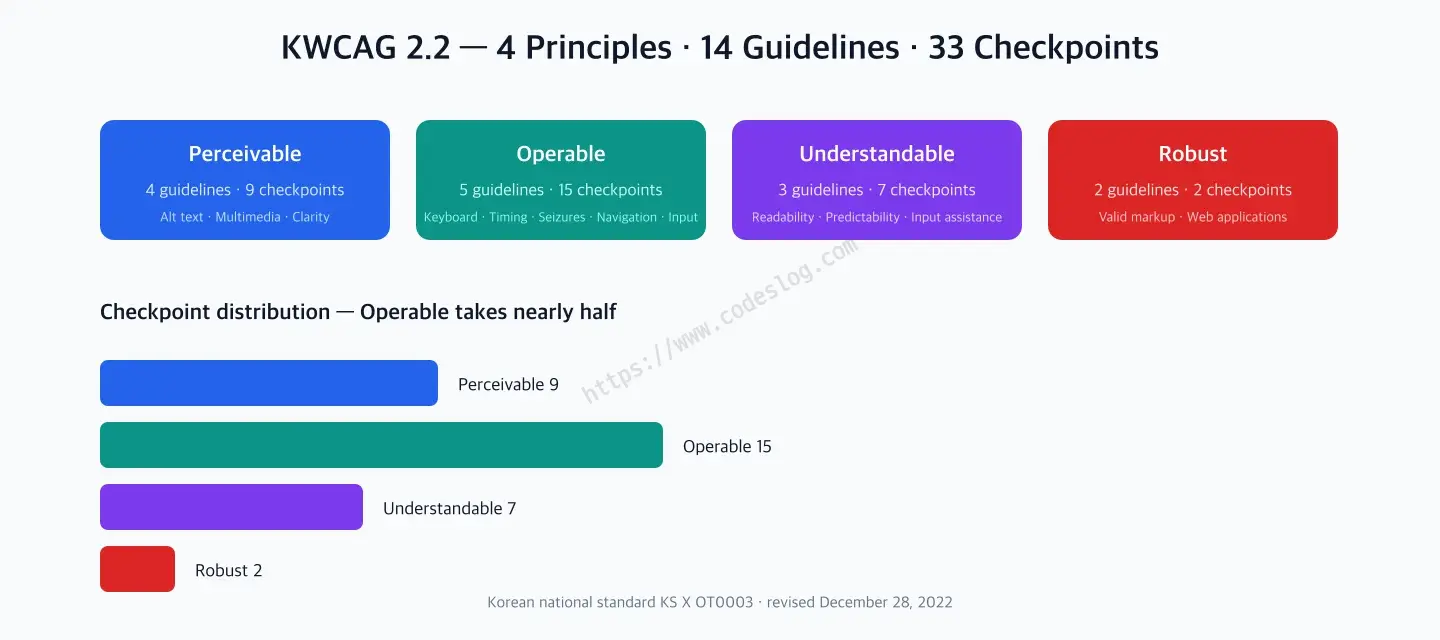
KWCAG 2.2 is organized into 4 principles, 14 guidelines, and 33 checkpoints. The 4 principles mirror WCAG’s POUR structure (Perceivable, Operable, Understandable, Robust), forming a hierarchy: principles at the top, guidelines underneath, and checkpoints — the actual pass/fail items — below those.
| Principle | Guidelines | Checkpoints | Core focus |
|---|---|---|---|
| Perceivable | 4 | 9 | Items that make content perceivable — alt text, captions, color contrast, and more |
| Operable | 5 | 15 | Items covering operability — keyboard access, focus movement, pointer input |
| Understandable | 3 | 7 | Items that make content understandable — language markup, error correction, labels |
| Robust | 2 | 2 | Items ensuring assistive-technology compatibility — valid markup, web application accessibility |
| Total | 14 | 33 |
Just looking at the numbers, Operable has by far the most items. In practice, too, keyboard accessibility, focus management, and pointer input are the issue categories that trip up QA most often.
The 9 New Checkpoints Added in the 2022 Revision#
The December 2022 revision expanded KWCAG’s checkpoints from 24 to 33. Most of the 9 new checkpoints address modern interfaces — touch devices, voice recognition, and users with cognitive disabilities.
| New checkpoint | Requirement (in short) |
|---|---|
| Character Key Shortcuts | Allow single-character shortcuts to be turned off, remapped, or active only on focus |
| Fixed Reference Points | Provide page numbers and page navigation for paginated e-publications like e-books |
| Single Pointer Input Support | Make every function usable with a single click or tap — no multi-touch or dragging required |
| Pointer Cancellation | Trigger actions on release, not on press, so users can cancel |
| Label in Name | Make sure the visible label text is included in the accessible name |
| Motion Actuation | Provide a button alternative for features triggered by shaking or tilting |
| Consistent Help | Place repeated help and contact information in the same relative location across pages (“Consistent Help”) |
| Accessible Authentication | Don’t rely solely on cognitive function tests (memorizing passwords, solving puzzles) — support other authentication methods too |
| Redundant Entry | Don’t ask users to re-enter information they already provided earlier in the same process |
Except for Fixed Reference Points, these all roughly track existing WCAG success criteria — the pointer, shortcut, and label criteria added later in WCAG 2.1, plus the Consistent Help, Accessible Authentication, and Redundant Entry criteria newly defined in WCAG 2.2. Fixed Reference Points has a stranger backstory. It was adapted from a Page Break Navigation criterion that appeared in an early WCAG 2.2 draft — but that criterion got dropped from the final WCAG 2.2 during standardization. So it now survives only in KWCAG. Overall, the domestic standard caught up with the international one, just a few years behind.
KWCAG Did Not Adopt All of WCAG 2.1#
There’s a detail practitioners often miss: KWCAG was built “based on” WCAG 2.1 — it wasn’t copied over wholesale. The standard’s own text says as much.
“This standard was drafted based on the W3C’s WCAG 2.1 (published in 2018), but focuses primarily on the essential items from the international standard that must be complied with, considering factors such as the impact on Korean industry as a whole.”
In other words, KWCAG was built by selecting the WCAG 2.1 criteria judged essential for the Korean web industry, with some WCAG 2.2 concepts (the new checkpoints covered above) folded in as well. So if an overseas client asks for “WCAG 2.1 AA compliance” and a Korean team answers “we’re KWCAG 2.2 compliant, so we’re covered,” the two sides might be talking past each other. Both guidelines share the same roots, but their checklists don’t line up exactly — on international projects, it’s worth nailing down which standard applies at the contract stage, to avoid rework later.
How Law and Certification Connect#
The Anti-Discrimination Against Persons with Disabilities Act (장애인차별금지법, Korea’s law prohibiting discrimination and requiring reasonable accommodation for people with disabilities) is the legal basis for web accessibility obligations in Korea. Under this law, public institutions and businesses above a certain size are responsible for ensuring accessibility. In April 2026, Korea’s Supreme Court actually ruled that an online shopping mall’s failure to provide alt text for images constituted discrimination. (I covered this in more detail in the analysis of the 2025 Web Accessibility Survey.)
The Ministry of the Interior and Safety’s e-government website quality management guidelines and the Korea Government Design System (KRDS, 정부 디자인 시스템) also treat KWCAG 2.2 as the compliance baseline, so on public-sector projects KWCAG 2.2 becomes the practical requirement. On a side note, you’ll sometimes see articles claiming e-government websites must comply “by 2026” — I wasn’t able to confirm any official source backing that deadline. The certification system follows the same logic: Web Accessibility Quality Certification (WA Certification) has evaluated against KWCAG 2.2 since January 2025, requiring a compliance rate of 95% or higher in expert review and a 100% task success rate in user review.
Correcting a Common Myth: “KWCAG Was Revised in 2025”#
You’ll run into articles claiming “KWCAG was revised in 2025” fairly often when searching around. To be clear upfront: that’s not accurate. The current version in effect is still KWCAG 2.2, revised on December 28, 2022, and there’s no official source confirming that a new revision came out in 2025.
The likely source of confusion is that a 2025 accessibility survey and news about certification review switching to KWCAG 2.2 got tangled up with the word “revision.” The guidelines themselves and the certification system are two separate things, but it’s an easy mix-up to make.
When’s the Next Revision?#
Korea’s broadcasting and telecommunications standardization guidelines call for a 5-year review cycle for national standards. Since KWCAG 2.2 was revised in December 2022, simple arithmetic puts the next review around 2027. That’s a “review,” not a guaranteed revision, of course, and the direction could shift depending on what happens with the international standard (WCAG 3’s progress). A lot of people ask how WCAG 3 and KWCAG relate to each other, so I’m planning to cover that separately in an upcoming post.
Honestly, though, even as I write “the next review is 2027,” I’ve been half-tempted to set a calendar reminder for myself. Standards documents aren’t the kind of thing you can read once and then forget about for a few years.
One-page summary#
- KWCAG 2.2 is the national standard KS X OT0003:2022, and the version revised on December 28, 2022 is currently in effect (a “2023 revision” usually means someone copied the explanatory guide’s date). The year after the colon identifies the edition; drop it when the edition doesn’t matter.
- Its structure is 4 principles, 14 guidelines, 33 checkpoints. The 2022 revision added 9 new checkpoints, expanding the total from 24 to 33.
- It’s built on WCAG 2.1 but selectively adopts mostly the essential items — it’s not a straight copy of WCAG.
- The Anti-Discrimination Against Persons with Disabilities Act is the legal basis, and the e-government website quality guidelines and KRDS also treat KWCAG 2.2 as the compliance baseline.
- The claim of a “2025 revision” isn’t accurate, and the next review is expected around 2027.
Leave a comment