“Once WCAG 3 ships, what happens to the KWCAG we’re following right now?”
That’s the question I get most often since publishing our complete KWCAG 2.2 guide. “WCAG 3” has started coming up often enough in accessibility newsletters and conference talks that it’s only natural to wonder how KWCAG, our domestic standard, should respond to this shift.
Short answer up front: the two standards are moving at different speeds right now, and there’s no need to relearn KWCAG anytime soon. That said, a fairly significant structural shift is on the horizon, so it’s worth knowing the general direction if you work in this space. This post walks through what’s different between the two standards and why that difference matters.
KWCAG and WCAG 3: How the Two Standards Are Related#
KWCAG wasn’t built as an independent standard from scratch. It’s a national standard (KS X OT0003) built on top of WCAG 2.1, which W3C published in 2018, selecting and adapting the items essential to Korea’s domestic industry environment. Some concepts from WCAG 2.2 were folded in later, but the underlying skeleton is still WCAG 2.1’s POUR structure (Perceivable, Operable, Understandable, Robust).
But WCAG 3 (WCAG 3.0), the next-generation standard W3C is currently developing, doesn’t use the POUR structure at all. The very skeleton KWCAG is built on ends up disappearing from the international standard by its next version.
Structure Compared: The Numbers Tell a Different Story#
As of July 2026, WCAG 3 is still at the W3C Working Draft stage — an official draft, not a final Recommendation. I covered exactly where the draft stands in my full rundown of the March draft.
| Aspect | KWCAG 2.2 | WCAG 3 (March 2026 Draft) |
|---|---|---|
| Foundation | Partial adoption of WCAG 2.1 + some WCAG 2.2 | New design by W3C |
| Top-level structure | 4 principles (POUR) | 12 topic categories |
| Middle tier | 14 guidelines | 44 guidelines |
| Base-level items | 33 checkpoints | 153 requirements (92 Core + 61 Supplemental) + 28 Assertions |
| Standard stage | Finalized, in force as national standard | Working Draft |
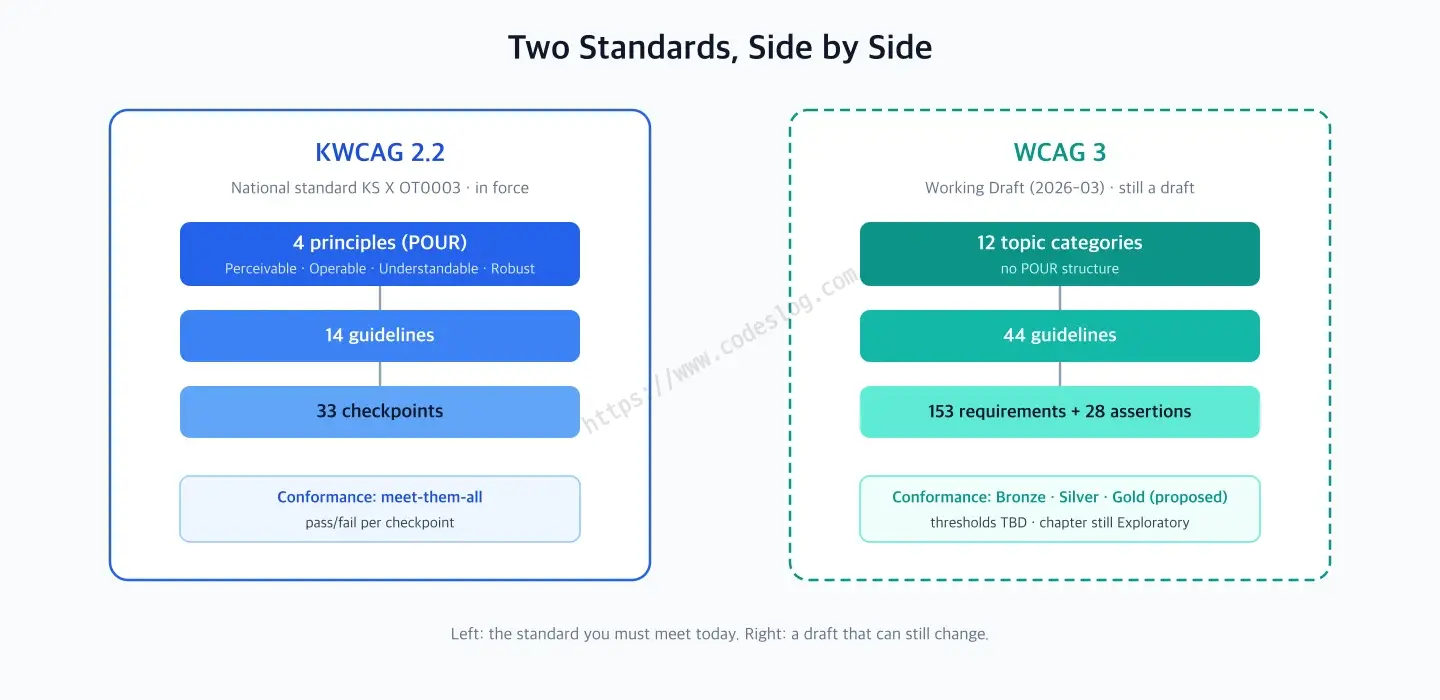
Even just from the numbers, WCAG 3’s item structure is far more granular. 33 checkpoints versus roughly 150 requirements is a difference in scale, not just degree, which makes a simple one-to-one mapping table impractical.
What It Means for POUR to Disappear#
If you’ve worked with KWCAG hands-on, you’re probably used to saying things like “that’s a Perceivable violation.” That four-principle classification wasn’t just a table of contents — it was the shared language teams used to diagnose accessibility issues and talk to each other about them.
WCAG 3 drops that language and reorganizes requirements into 12 topic categories instead. W3C’s public materials don’t clearly state why, but a commonly cited reason is that as the number of items grew, the four principles alone became too limited to capture requirements with such varied characteristics.
Given that KWCAG’s own structure is built directly on top of POUR, this isn’t just a terminology change — it means KWCAG may eventually need a structural redesign if it wants to stay aligned with the international standard. That’s a story for after WCAG 3 becomes a final Recommendation, though, not something happening right now.
The Conformance Model Is a Completely Different Approach, Too#
KWCAG uses an all-or-nothing model — did you meet this checkpoint, yes or no. To get certified, you need to hit a passing bar on most of the checkpoints.
WCAG 3 is different. It proposes judging how well individual features meet requirements at the level of a functional performance statement, then rolling those up into Bronze, Silver, and Gold tiers. The specific thresholds that separate the tiers are still marked “to be determined,” though, and it isn’t a scoring-and-summing system either. The conformance chapter itself is still marked Exploratory, so it’s hard to say from the draft alone what its final shape will look like.
Accessibility Support Sets and Korea#
WCAG 3 introduces a concept called the “Accessibility Support Base Set” — the assistive-technology/browser combination that accessibility gets judged against. The draft standard states that the default set is built around English-language content, but the default set itself still isn’t concretely defined.
That said, the draft does include a provision allowing “regional regulatory bodies to designate an alternate set.” How that provision would apply in Korea, and whether a separate set reflecting Korea’s screen-reader and browser environment would get designated, is still unknown. There’s also no publicly announced plan yet for how Korean government agencies or institutions intend to prepare for WCAG 3.
The Two Clocks Converge in 2027#
As covered in our complete KWCAG 2.2 guide, KWCAG follows a five-year review cycle as a matter of policy under the Broadcasting and Communications Standardization Guidelines. Counting from the December 2022 revision, the next review is expected around 2027.
As it happens, the WCAG 3 working group has set Q4 2027 as its target for a Candidate Recommendation (CR) snapshot. CR is a stage before the final Recommendation, and the final Recommendation itself typically takes longer to arrive — based on the currently known schedule, that points to somewhere around 2029. That date, too, is just the working group’s goal, not a firm commitment.
It’s an interesting coincidence that the two standards’ review clocks converge around 2027. That doesn’t mean KWCAG will be revised in 2027 to incorporate WCAG 3, though — all we can really say is that the two timelines happen to overlap.
So What Should Practitioners Actually Do Right Now#
If you’ve read this far, you’re probably wondering “okay, so what do I actually do” — and the answer is refreshingly simple: keep following KWCAG 2.2 closely, for now. WCAG 3 is still a draft, and even its conformance criteria are at the exploratory stage, so there are no settled rules to apply in practice yet. Chasing a draft-stage standard at the expense of the KWCAG 2.2 you’re actually required to follow would be putting the cart well before the horse.
Instead, checking in on WCAG 3’s progress once or twice a year is plenty. It also helps to avoid anchoring your team’s internal understanding of accessibility too tightly to a specific framework like “the four POUR principles.” Even if the structure changes down the road, practical principles like “provide alt text” or “make everything operable by keyboard” are likely to hold up under whatever standard framework comes next.
One-page summary#
- KWCAG 2.2 is built on WCAG 2.1’s POUR (four-principle) structure, while WCAG 3 is organized around 12 topic categories and 153 requirements — the underlying skeletons are simply different.
- As of July 2026, WCAG 3 is still a W3C Working Draft, and its conformance chapter is still at the Exploratory stage.
- The conformance model differs too: where KWCAG uses an all-or-nothing model, WCAG 3 proposes Bronze/Silver/Gold tiers (thresholds still undecided).
- The default accessibility support set is built around English-language content, and while a provision lets regional regulators designate an alternate set, no plan has been announced for how Korea would respond.
- KWCAG’s 5-year review cycle (~2027) and WCAG 3’s CR target (Q4 2027) happen to overlap in timing, but that doesn’t signal an upcoming KWCAG revision.
- Right now, the thing to do is keep following KWCAG 2.2.
Leave a comment