Prologue#
I’d prepared for this talk as a natural extension of the work I do every day, so I didn’t expect to be particularly nervous. But when I saw the list of other presenters ahead of time, I found myself wanting to do justice to the occasion — to make sure my talk held its own alongside theirs.
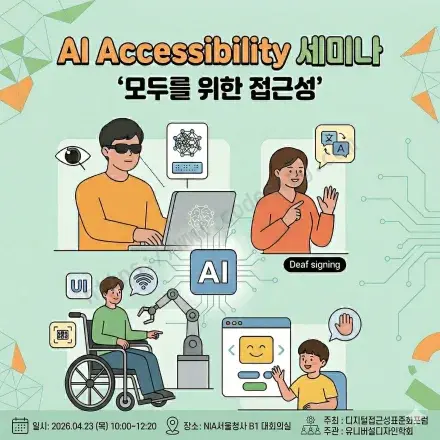
Event poster
So I put together clean slides, wrote out a full script, ran through a few rehearsals — and headed to Seoul. The trip from Daegu isn’t exactly short, but I was in good spirits. There’s something about being needed, about being put to use, that makes you feel alive.
About the Seminar#
On April 23, 2026, “A Seminar on Developing Strategies for AI Accessibility for All” was held in Seoul — hosted by the Digital Accessibility Standardization Forum, organized by the Universal Design Society, and sponsored by NIA (Korea Intelligence Information Society Agency) and TTA (Telecommunications Technology Association).
The venue was the NIA Seoul office. Pre-registration filled up quickly, reflecting just how much interest this topic is generating right now.
The core theme: “Ensuring that all citizens can use AI services without difficulty.” This was a space for policy and technology leaders to come together around the intersection of AI and accessibility. I was honored to present at this event.
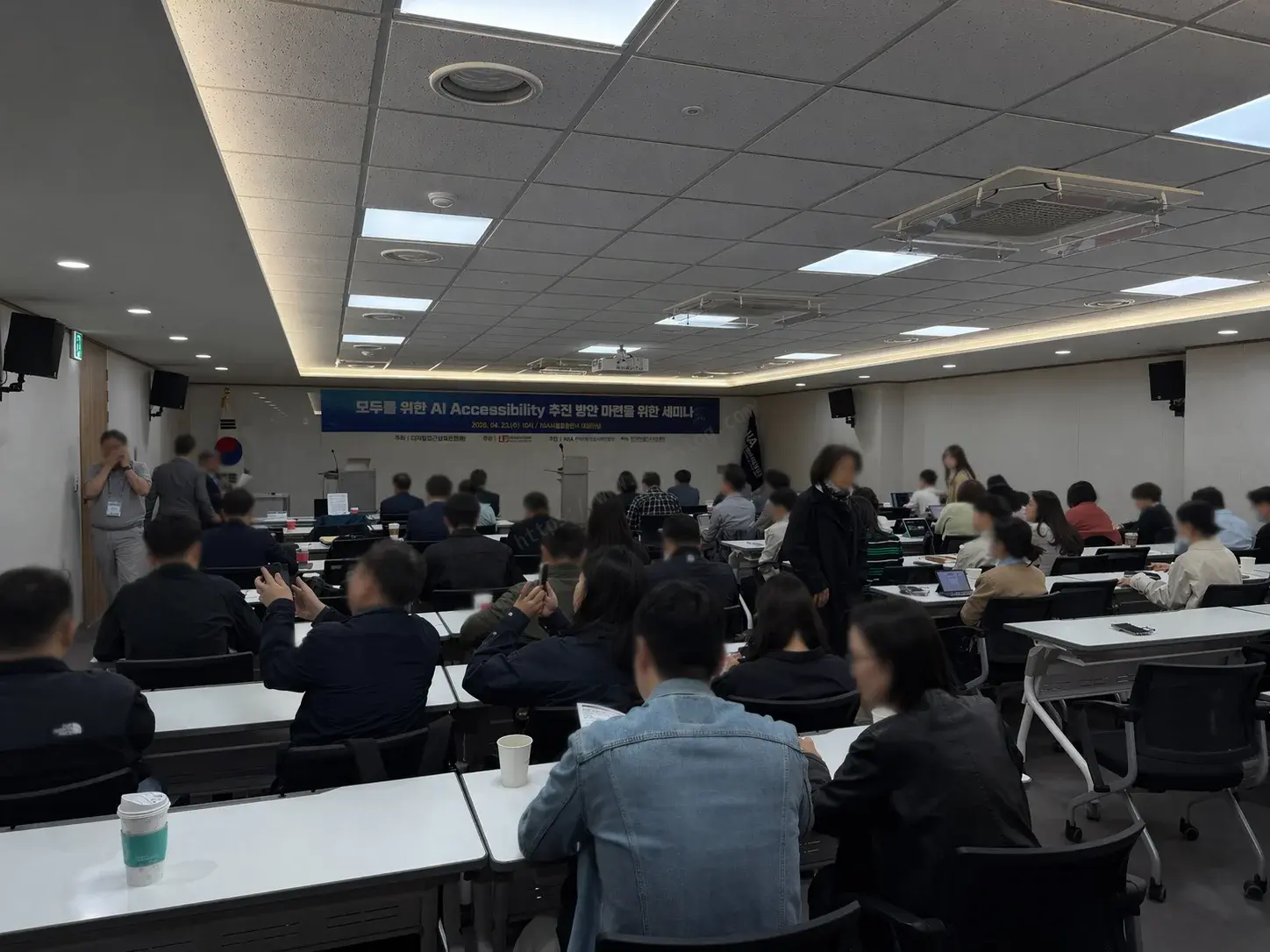
Photo taken at the event
My Presentation: A Journey Toward a Happier Web#
My talk was titled “A Journey Toward a Happier Web — The ModuWeb Story.”
It wasn’t a flashy technical deep-dive. It was an honest account of the problems I encountered in the field and the journey of trying to solve them.
The schedule ran a little behind on the day, so I trimmed my presentation slightly on the fly. The full content of what I prepared is below — from the origin of ModuWeb to where I hope it goes.
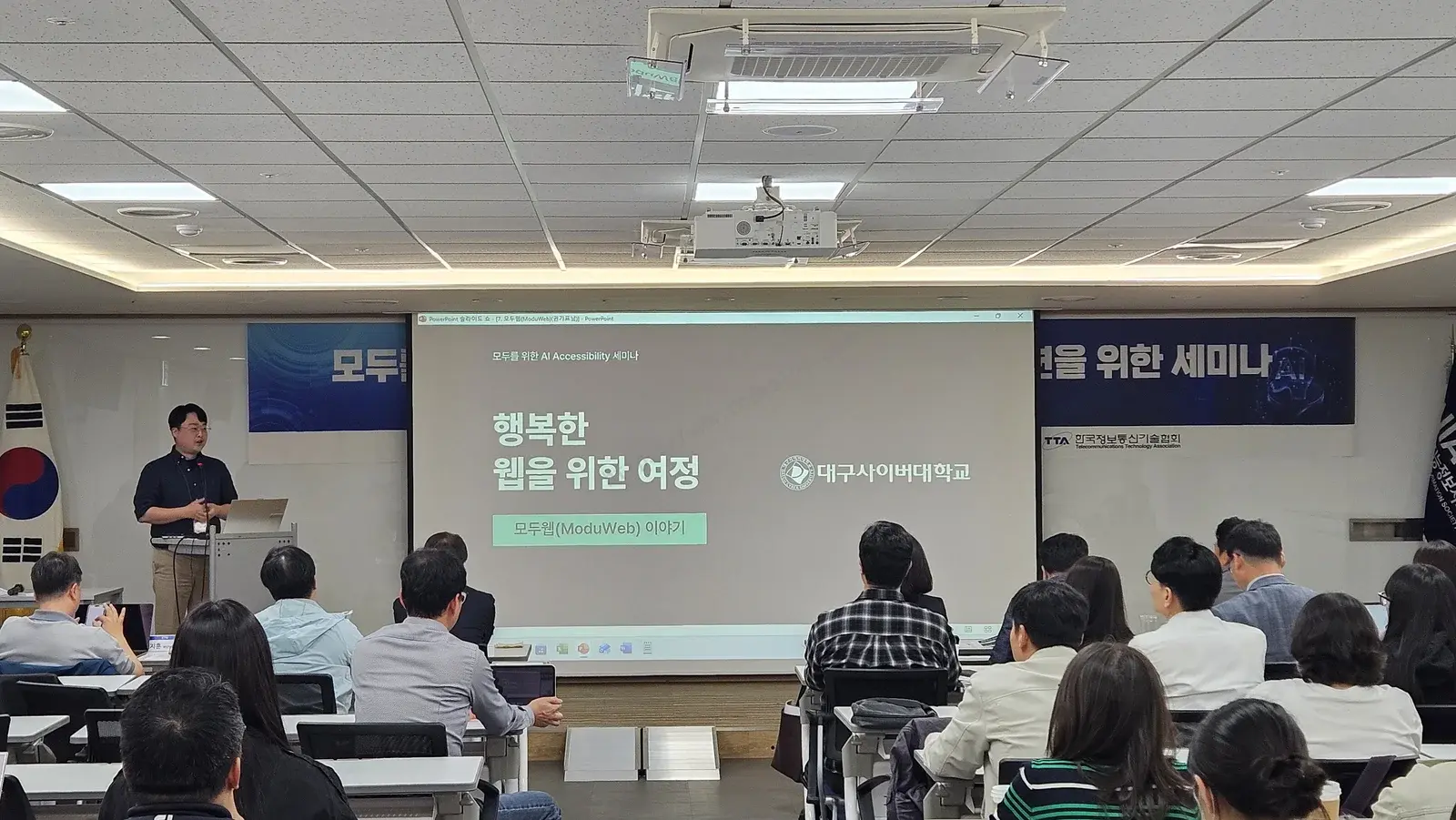
Photo: NIA
Recognizing the Problem — The Outside World Was Different#
I work on the web services team at Daegu Cyber University, where I build and maintain the university’s web platforms. We’re a special education-focused university, and our learning management system has earned a web accessibility quality certification. So honestly, I thought we were doing fine.
Then I saw what was happening outside.
While conducting a field survey on educational welfare support for students with disabilities, I encountered a sobering reality:
- Staff who had no idea what web accessibility even was
- Systems that were certified but practically unusable
- Environments where downloading a single lecture file was a struggle
For private companies and small websites, the situation was even worse.

Photo: Masaaki Komori on Unsplash
“While we were feeling reassured, someone out there couldn’t even get through the front door.”
Why ModuWeb Was Born#
After seeing that, I had one question:
“How can we help?”
If we could use what we’re already good at to reach more people — that’s where ModuWeb began.
ModuWeb is an overlay-style web accessibility assistance tool. Add a single script to your website, and users can adjust accessibility settings to suit their own needs. And it’s open source.

Photo: Headway on Unsplash
Key Features#
So anyone can use the web in their own way.
| User Group | Features |
|---|---|
| Low vision | Text enlargement, color inversion, cursor highlighting, TTS |
| Deaf/hard of hearing | Media playback controls |
| Motor impairments | Keyboard navigation, enhanced focus indicators, STT |
| Cognitive disabilities | Reading assistant, word spacing adjustment |
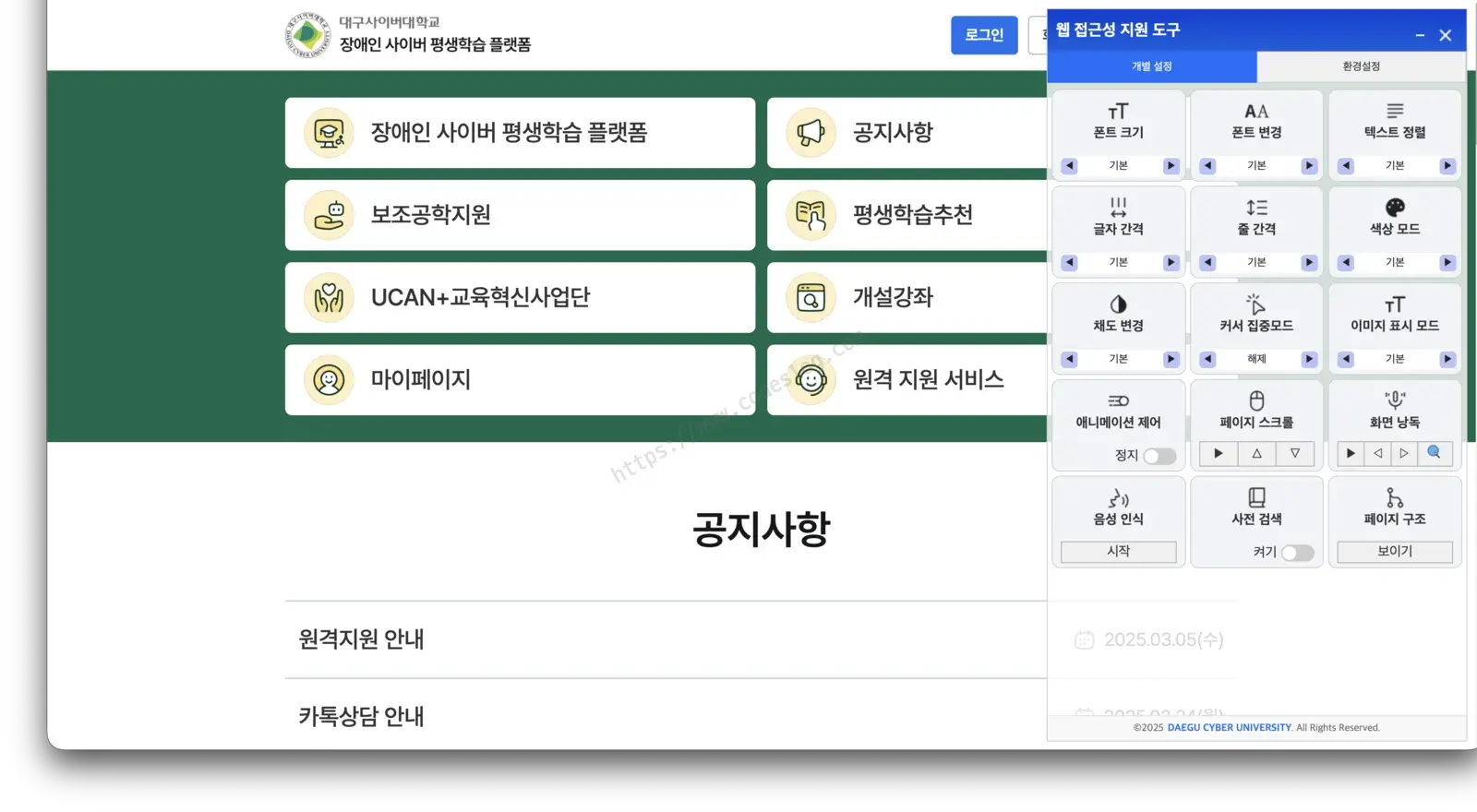
Image: ModuWeb running live
An Honest Admission — The Limits of Overlay Tools#
This was the slide I agonized over most.
Overlay tools are controversial. I had to be upfront about that.
- Root causes unresolved: They don’t actually fix accessibility issues at the code level.
- Community opposition: Groups like IAAP argue that overlays delay real solutions.
- Risk of UX harm: A poorly implemented overlay can actually make things worse for assistive technology users.
These criticisms are valid. I’m not dismissing them.
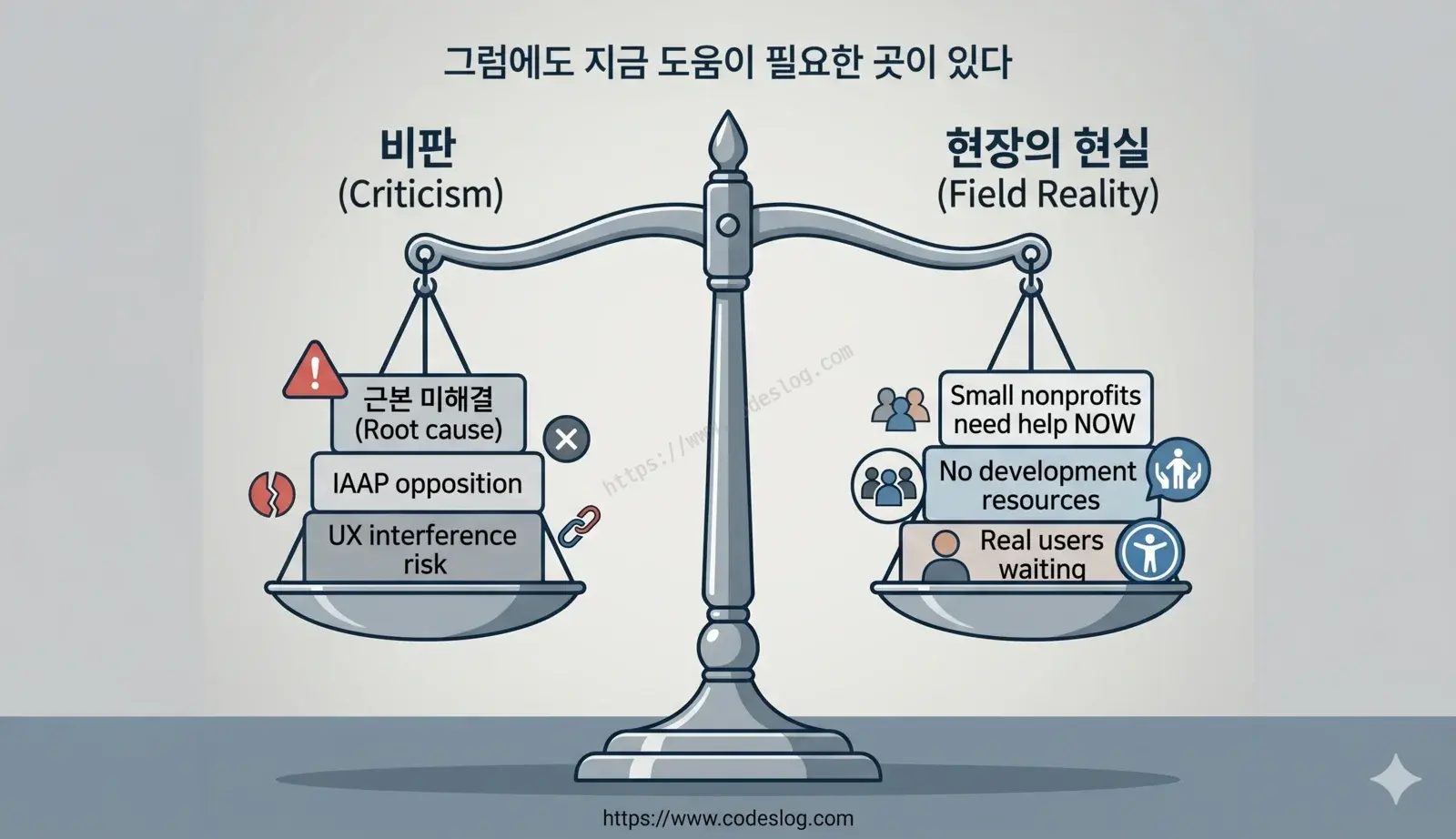
Image: Generated with Nanobanana AI
But here’s the thing:
“There are places that can’t afford to wait for the debate to be settled.”
Where It’s Still Needed#
There are organizations that genuinely can’t implement full accessibility right now:
- Small public agencies & local governments — Limited development capacity
- Nonprofits & welfare organizations — Constrained budgets and staffing
- SMEs & educational institutions — Unfamiliar with accessibility requirements
For users with low vision, motor disabilities, and cognitive differences at these organizations — the impact of ModuWeb is real and immediate. That’s why it exists.
ModuWeb’s Three-Stage Journey#
ModuWeb isn’t stopping at overlays.
| Stage | Description | Status |
|---|---|---|
| STAGE 1 | Overlay support tool — users adjust accessibility themselves | Live |
| STAGE 2 | Accessibility audit & guidance — developers self-improve | In planning |
| STAGE 3 | Accessibility built-in — a web that needs no overlay | Vision |
Accessibility is no longer something to tackle “later.”
In STAGE 2, ModuWeb will analyze real-time WCAG compliance for sites using it, and use AI to provide concrete code improvement guidance. STAGE 3 envisions a web where every user can access everything — not because of an add-on tool, but because accessibility was built in from the start.
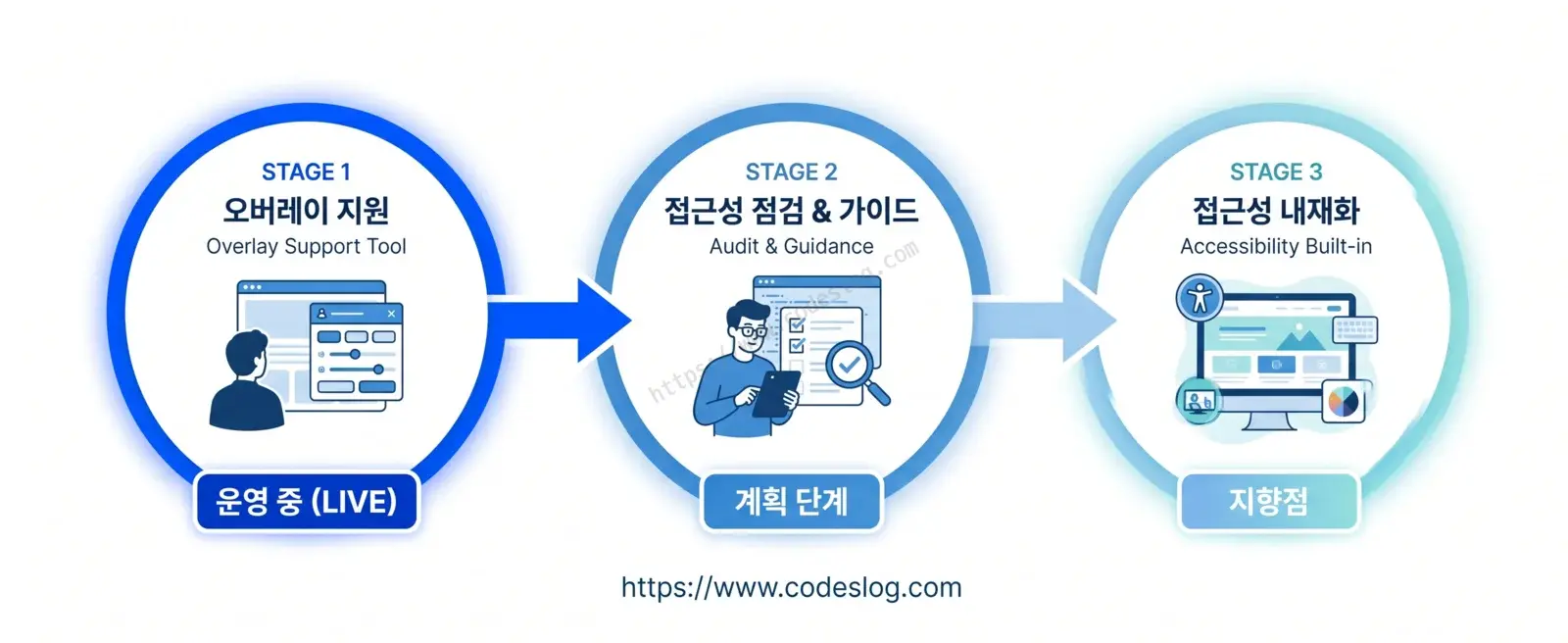
Image: Generated with Nanobanana AI
Presentation Slides#
Session Highlights#
The keynote by Professor Ka Hyeon-wook was nothing short of paradigm-shifting. Even before my own turn came, he’d already given me a lot to think about. His framing around the shift from DOM to COM (Contextual Object Model) resonated deeply and opened up a new lens through which to think about the future of development. The insight that accessibility must now extend to invisible, contextual data — not just what appears on screen — struck me as a genuinely important shift in perspective.
The presentation from Microsoft Korea’s Lee Geon-bok gave me a fresh angle on AI and human capability augmentation, and the cycle of how training data flows through AI and back into human use. Data as both input and output — the loop matters.
Samsung Electronics’ Baek In-ho followed, and I was impressed by the scope of Samsung’s accessibility work — from smartphones (now a basic life tool) to smart TVs, home appliances, and AI home environments. It’s a glimpse into why Samsung is the company it is right now. One feature in particular — call screening — sparked thoughts I’d love to explore further. I hope I get the chance to have that conversation with Baek In-ho directly.
Companies like LG, Apple, and Google have all been working on digital inclusion in their own ways, but seeing Samsung and Microsoft present in the same room made the lived, everyday dimension of accessibility feel very concrete.
The most grounded view of that came from Kim Chan-hong of A11y Research Institute, who showed how AI tools are actually being used in daily life — walking through Google Gemini as a real-world case study. Together with Professor Ka’s framing of the COM era, it gave me a clearer picture of where accessibility is heading.
From ETRI, Choi Ji-hoon presented an AI-based accessibility analysis and conversational agent — a project currently in development (April 2025 – December 2027). I’d seen some materials on this before, so it was exciting to see it in motion. The area it addresses — surfacing accessibility issues and guiding users toward solutions — overlaps closely with something I’ve been thinking about for ModuWeb. Very much on my radar.
(A note on order: Choi Ji-hoon’s talk was actually between Samsung’s and A11y Research Institute’s presentations, but I’ve reordered them here to make the narrative flow more naturally.)
Finally, Lee In-gu of EqualForAll wrapped up the day. EqualForAll is well-known in the AI accessibility space, so seeing their work up close was genuinely exciting. I’d long admired the company from afar — meeting Lee In-gu in person was an honor.
He presented their AI-powered sign language translation program, and I was struck to learn that EqualForAll holds the second-largest sign language training dataset in the world. For a Korean company, that’s remarkable. I’m looking forward to seeing where their services go from here.
They also touched on Ongul, a service that converts complex text into plain, accessible language — something I’ve had on my mind recently. It ties directly into the COM shift Professor Ka described, and I think it’s going to be one of the defining challenges in accessibility going forward.
Closing Thoughts#
The last slide of my presentation contained this line:
“Accessibility is not a feature — it’s digital consideration for others.”
Beyond the technical checklists, I wanted to talk about the mindset that people who build the web should carry.
ModuWeb still has a long road ahead. There are shortcomings, and I welcome the criticism. But the reason I keep going on this journey is simple:
I want to build a happier web — together.
Leaving today’s forum, I find myself sitting with a question: in a world moving so fast around AI, how do we hold onto web accessibility — and keep the web equal for everyone? WCAG 3.0 is coming, and Korea’s KWCAG will need to follow. Where accessibility goes from here is genuinely hard to predict right now. But one thing feels clear: the fundamentals still matter, and we need to keep studying and applying them.
I’m still asking myself what role I can play. I hope the answer turns out to be something that reaches a lot of people.