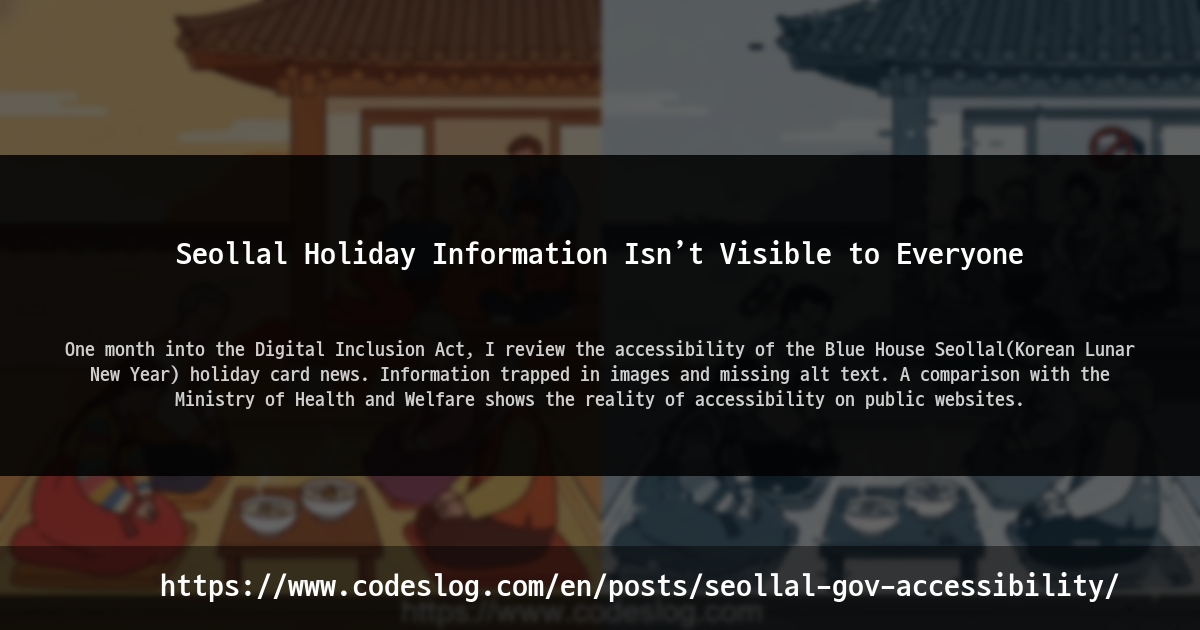
This essay records what I have wrestled with on the ground about web accessibility, public web services, and the responsibilities of developers.
Between law and technology, standards and reality, I try to answer the question: “Are we truly building for everyone?”
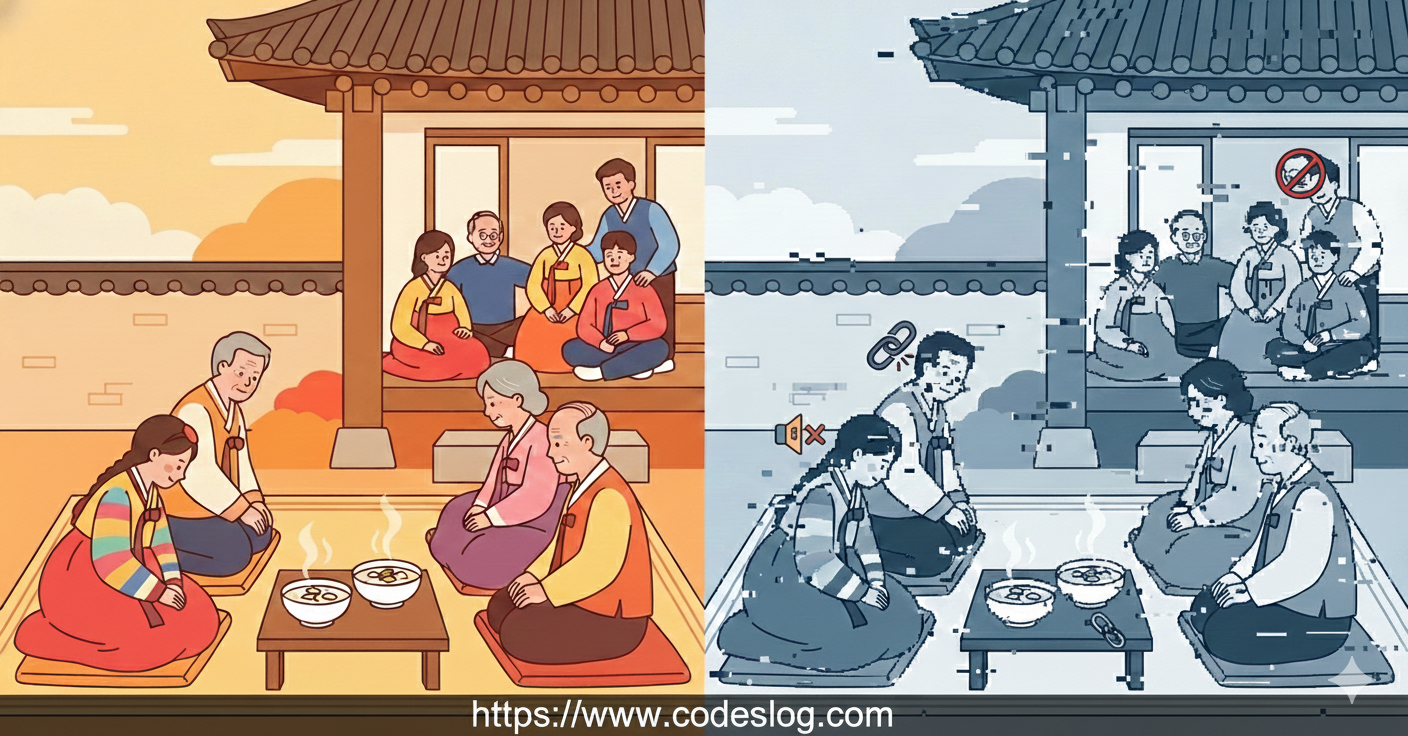
Produced by: Nano Banana
Ahead of the Seollal(Korean Lunar New Year) holiday, I browse the web to find helpful information. Seollal(Korean Lunar New Year) is a uniquely Korean holiday. As I visit site after site, the first thing I often encounter is an auto-rotating banner or card news. Around Seollal, these banners include important government notices like emergency information.
But what if you cannot see?
A screen reader reads those card news images like this: “Image.” That is all. Emergency room locations, clinic hours, duty pharmacies — all of it exists only inside images, and there is no text in the HTML. There is no alternative text either. The information clearly exists, but for someone, it is not visible.
This year, ahead of Seollal, I scanned several government websites with a screen reader. I was especially curious this time because this was the first Seollal holiday since the Digital Inclusion Act took effect. Less than a month after the state promised “digital inclusion” by law, I wanted to see whether state institutions were keeping that promise.
1. The Digital Inclusion Act: One Month In#
In earlier posts in this series, I summarized the background and key points of the Digital Inclusion Act.
- Beyond accessibility, toward digital inclusion — the start of a new era
- Beyond technology, toward people — understanding the Digital Inclusion Act
In short, the law was enacted on January 21, 2025 and took effect on January 22, 2026. It strengthens accessibility and usability requirements for public and private services and codifies the state’s responsibility to reduce digital inequality.
Twenty-four days after the law took effect, I compared two sites posting Seollal-related notices — the Blue House and the Ministry of Health and Welfare.
2. The Blue House: Where It Starts to Go Wrong#
A hard-to-control main banner#
When you enter the Blue House website (president.go.kr), the first screen shows an auto-rotating slide banner. The problem appears immediately. The control buttons are far too small.
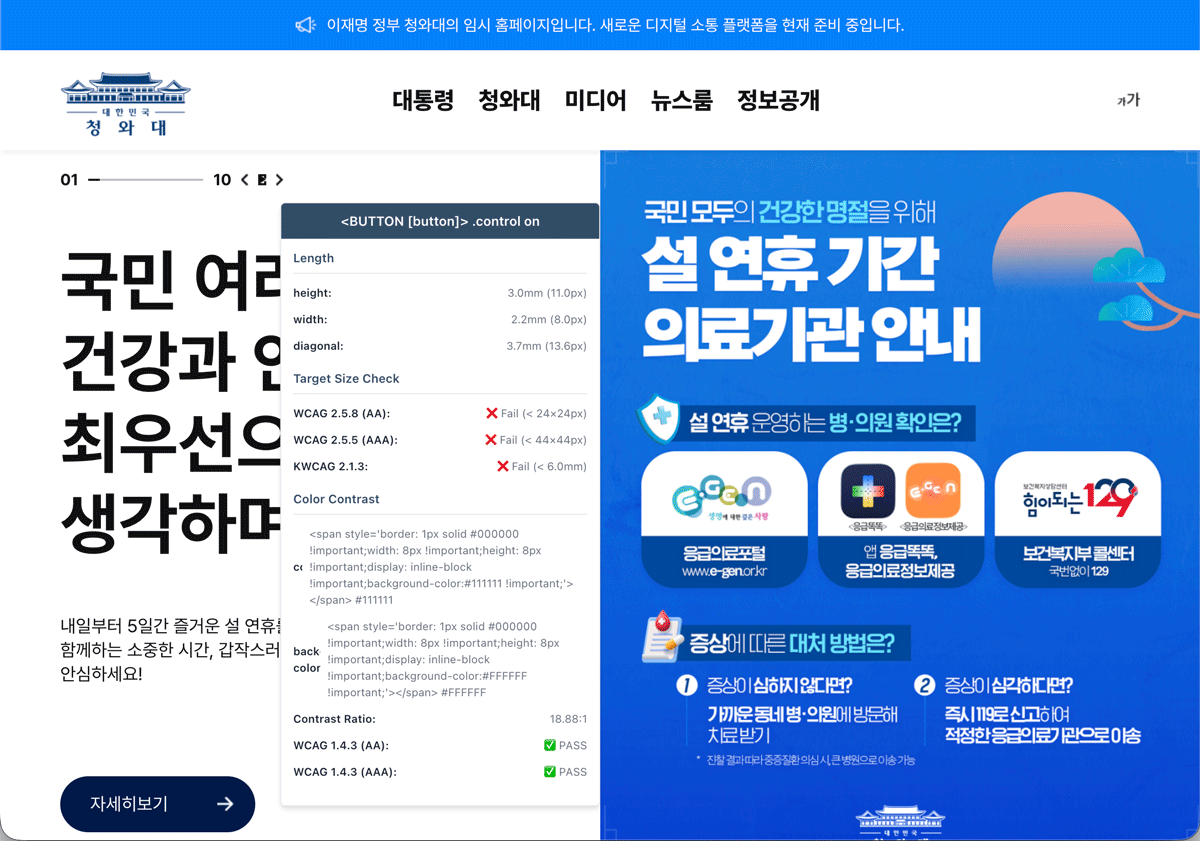
Blue House main banner (as of February 2026)
Card news: Seollal holiday medical facility hours#
This is the page I mentioned at the beginning. The Blue House provides Seollal-related information as card news.
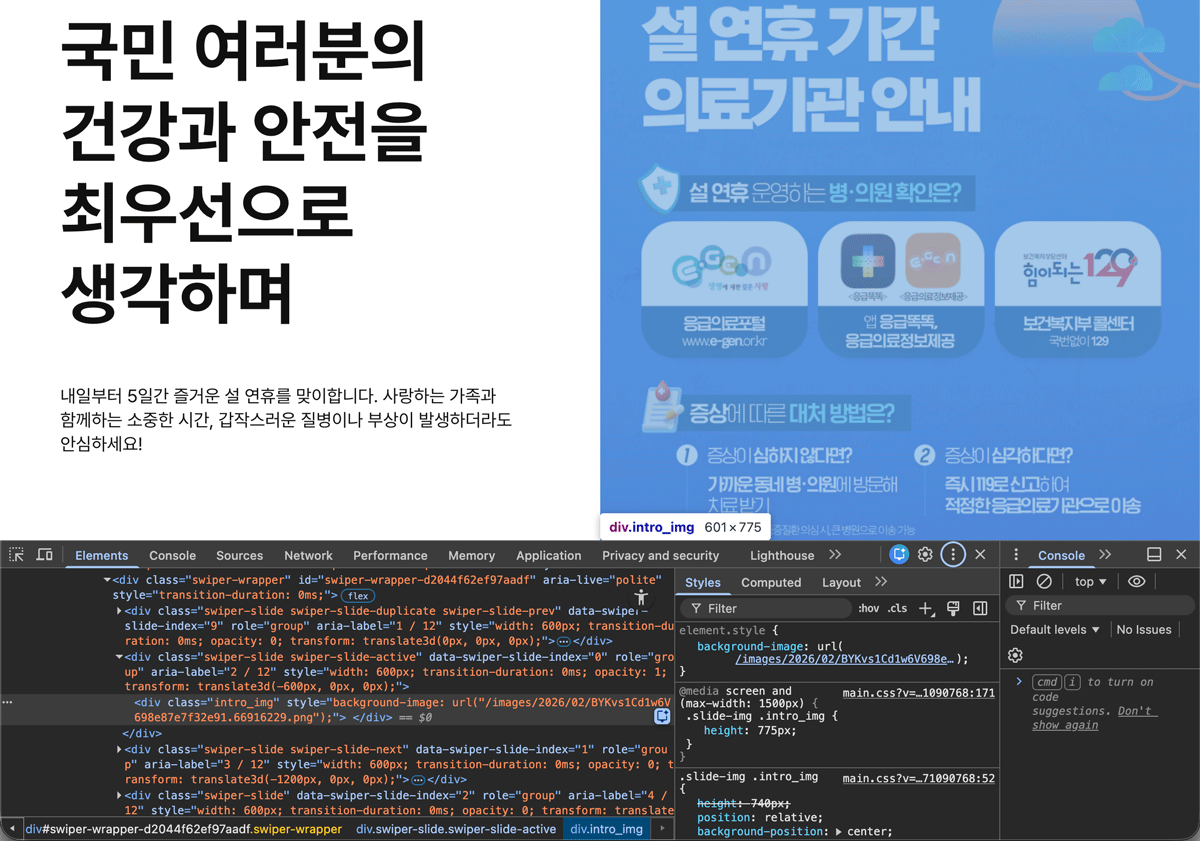
Blue House card news: Seollal holiday medical facility hours
It explains how to check which clinics are open and how to respond to symptoms. But all of the information exists only inside images. There is no text in the HTML body, and the images are delivered as background images. The site claims to prioritize public health and safety, yet it does not reach everyone.
The same is true on the detailed page. You are left with a sense of frustration about where the information can even be accessed.
For a blind person who needs to find a hospital during Seollal, there is no way to access this information. Yes, we all know we can call 119, or rely on our existing knowledge and experience. But people need help from their government.
KWCAG 2.2 Success Criterion 1.1.1 Text Alternatives: “Provide appropriate text alternatives so the meaning or purpose of non-text content can be understood.”
Card news: 2026 Seollal livelihood stabilization measures#
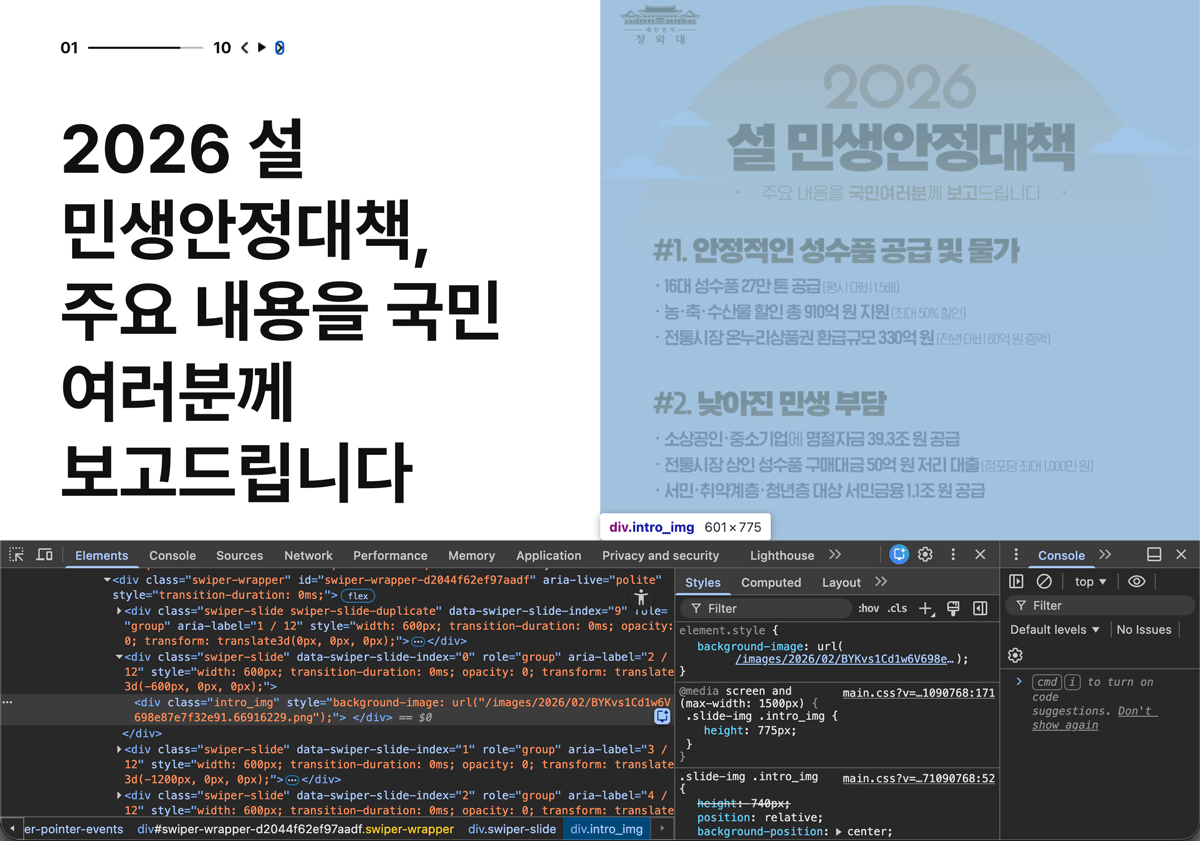
Blue House card news: 2026 Seollal livelihood stabilization measures
The livelihood stabilization card news has the same problem.
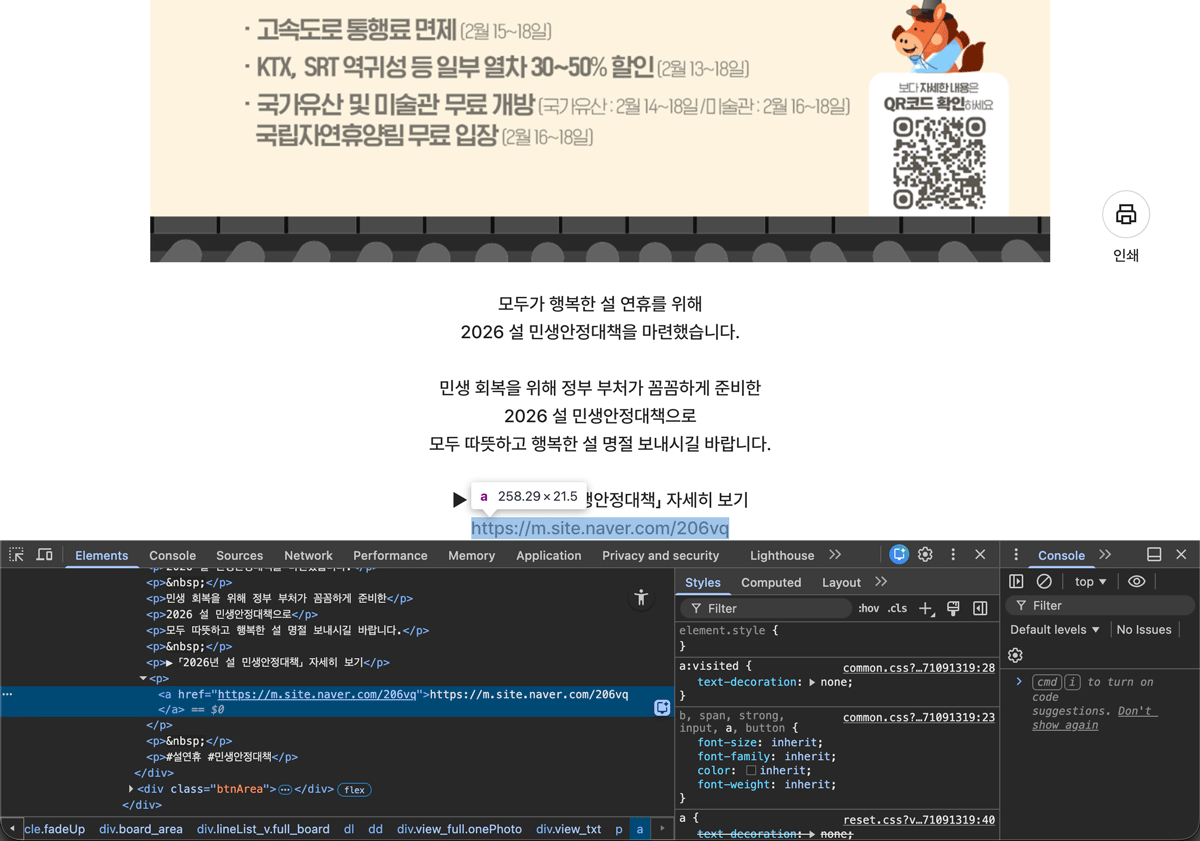
Blue House card news: 2026 Seollal livelihood stabilization measures
At the bottom of the detail page there is a “Read more” link that leads to an external page, but the redirect is not clearly announced. More importantly, the core problem remains: you cannot access the information on the page itself.
Providing information via external sites or attachments can be a fallback. But telling people to “get it elsewhere” when the main page does not provide the core content is not a real alternative.
3. The Ministry of Health and Welfare Was Different#
Two government institutions, but a different approach.
Main banner#
The Ministry of Health and Welfare website also has Seollal-related information on its main banner.
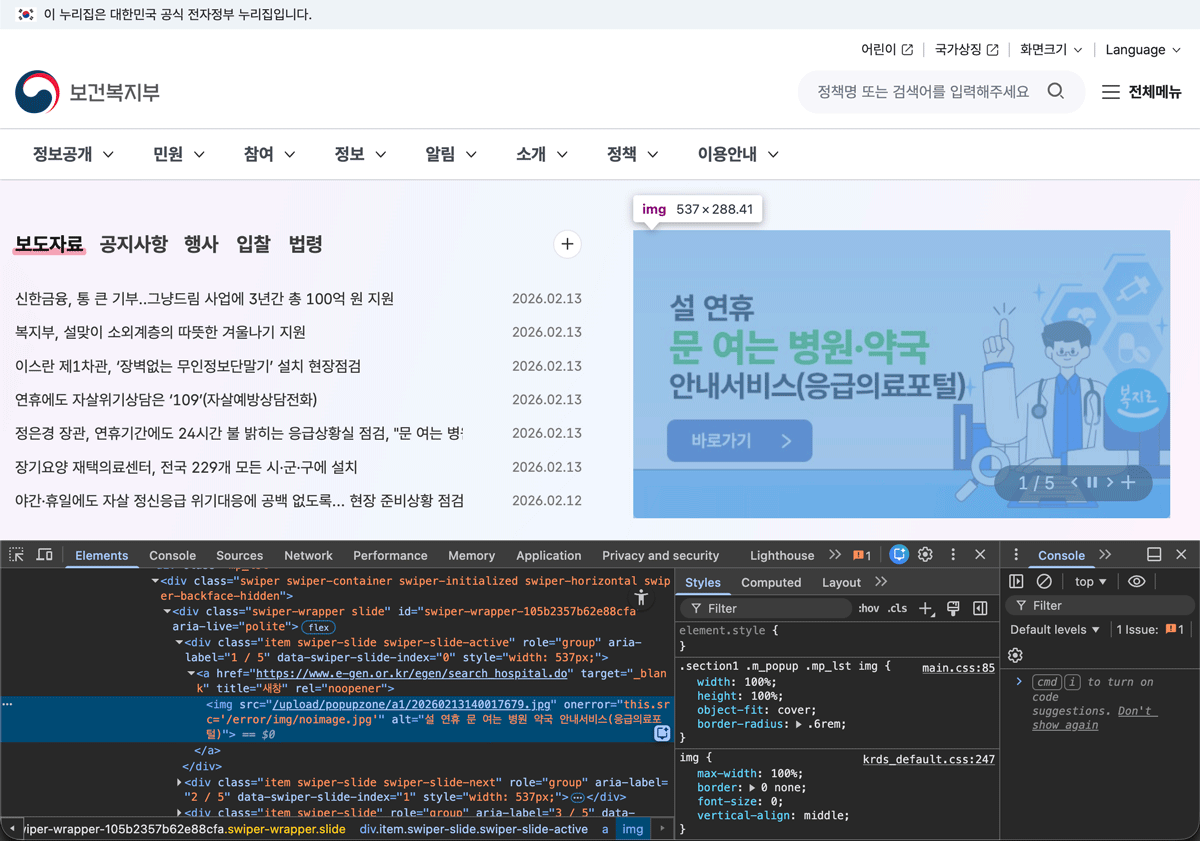
Ministry of Health and Welfare main banner: Seollal notice and slider controls (as of February 2026)
Compared with the Blue House, the difference is immediate.
| Item | Ministry of Health and Welfare | Blue House |
|---|---|---|
| Banner pause | ✅ Pause/Play button provided | △ Small button |
| Skip navigation | ✅ Skip to content/main menu | △ Basic structure only |
| Text alongside info | ✅ Also provided as text | ❌ Insufficient text |
Emergency Medical Portal — Seollal holiday hospital/pharmacy search#
The Ministry provides information on open hospitals and pharmacies during Seollal through the Emergency Medical Portal.
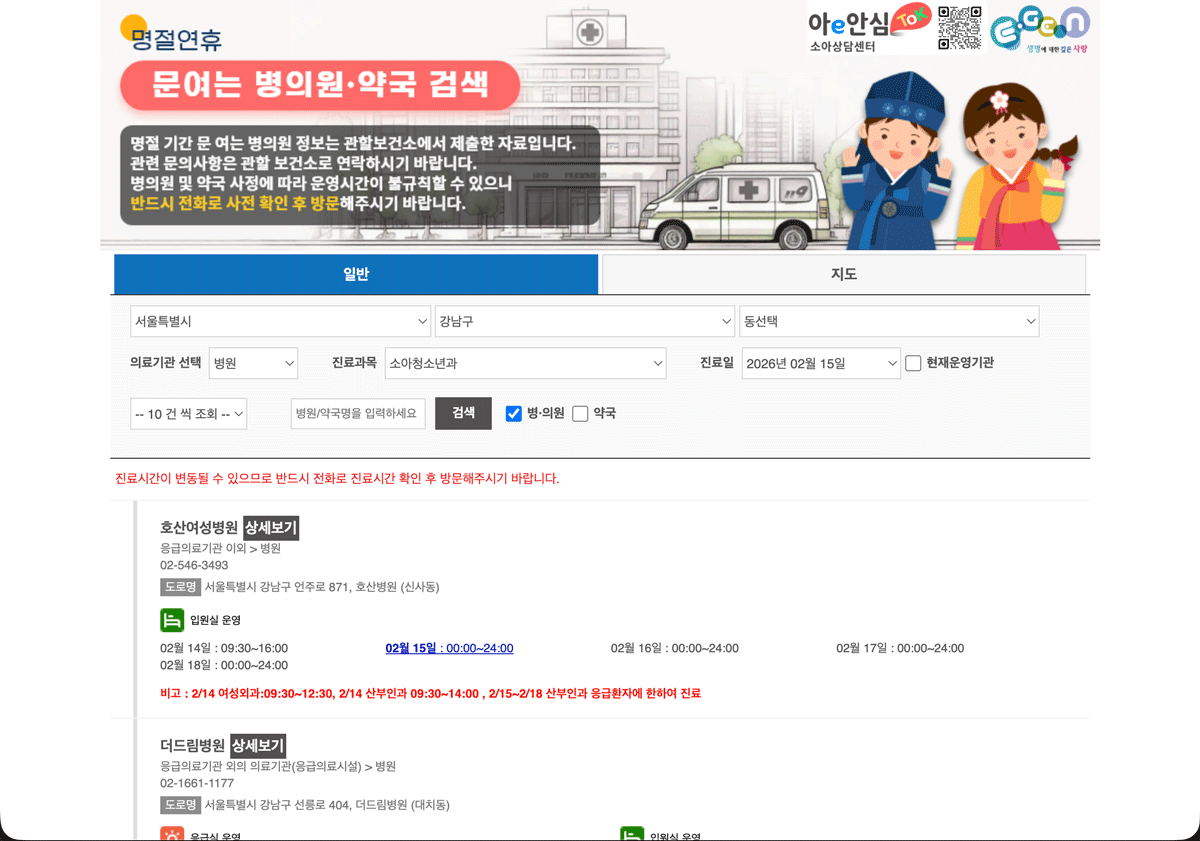
Emergency Medical Portal: Seollal hospital/pharmacy search
You can search by province/city/county with text-based results, and the site offers both map and list views. Because the results are text, they are accessible with a screen reader.
It is not perfect. There are still improvements to be made in form labels and ARIA attributes. But the site does follow the basic principle of providing information in text, which makes it fundamentally different from the Blue House.
4. Same Government, Different Awareness#
Here is a summary of Seollal-related accessibility across the two institutions.
| Evaluation | Blue House | Ministry of Health and Welfare |
|---|---|---|
| Slider pause | △ | ✅ |
| Image alt text | ❌ | △ |
| Info provided as text | ❌ | ✅ |
| Skip navigation | △ | ✅ |
The Blue House delivers information only as images. The Ministry of Health and Welfare provides it as text.
This is not about budget or technical skill. Within the same government, one does it and the other does not. This is a difference in awareness — whether accessibility was considered in the design stage by asking, “Who needs this information, and how will they access it?”
5. About the Card News Format#
While reviewing the Blue House site, one thing stood out again.
Card news is visually attractive, easy to share, and quick to consume. It is one of the most effective formats in the social media era. But from an accessibility perspective, it is also one of the most risky formats.
Because the core information gets trapped inside images. It looks like text, but machines recognize it as an image. “Isn’t it enough if you can see it?” becomes the underlying assumption, alt text gets skipped, and even if a low-vision user zooms in, the text inside the image does not scale.
But the fix is not difficult. Provide the same content as text below the image. Put the content into the image’s alt text, or provide it with an IR technique. If you attach a file, make sure it is in an accessible format. I am not asking anyone to abandon design. The point is simply this: do not deliver the same information in only one way.
6. What Must Change#
The Digital Inclusion Act states that national institutions must ensure accessibility for digital services.
It has been one month since the law took effect. I know it is unrealistic to expect everything to change overnight. But if public institutions that make and enforce the law do not follow accessibility even on their own websites, can they credibly demand it from the private sector?
Providing text alternatives for card news is not advanced technology. Adding an alt attribute to HTML does not require a large budget. The Ministry of Health and Welfare already does it. Spreading a practice that already exists within the government — to the Blue House and other institutions — is the minimum we can expect in the first year of this law.
Closing#
Looking up transportation to visit family during Seollal, finding a hospital in an emergency, checking the government’s livelihood policies — none of that is a given for everyone.
The world promised by the Digital Inclusion Act is one where all citizens can meaningfully use digital services. The first year of the law, the first Seollal. We still have a long way to go, but change must start somewhere.
I hope this post records that starting point. And that by next Seollal, we will be able to confirm a different outcome.