Introduction#
When people hear “accessibility testing,” they often think of a checklist: “Does this button have alternative text?” “Is the contrast ratio high enough?” WCAG 2.2 is built around clear pass/fail checks like these.
WCAG 3.0 moves toward a broader unit of evaluation, aiming to consider overall user experience quality. That shift naturally changes how we test. We now combine fine-grained checks (Atomic) with real-world contextual evaluation (Holistic).
This shift directly connects to the score-based conformance model discussed in WCAG 3.0 Conformance Model: Beyond A/AA/AAA. The weight you give each test type can change the score and the level you reach.
Important: This post is based on the WCAG 3.0 Editor’s Draft (2026-01-05). The Draft can change at any time, and this post may need updates as it evolves.
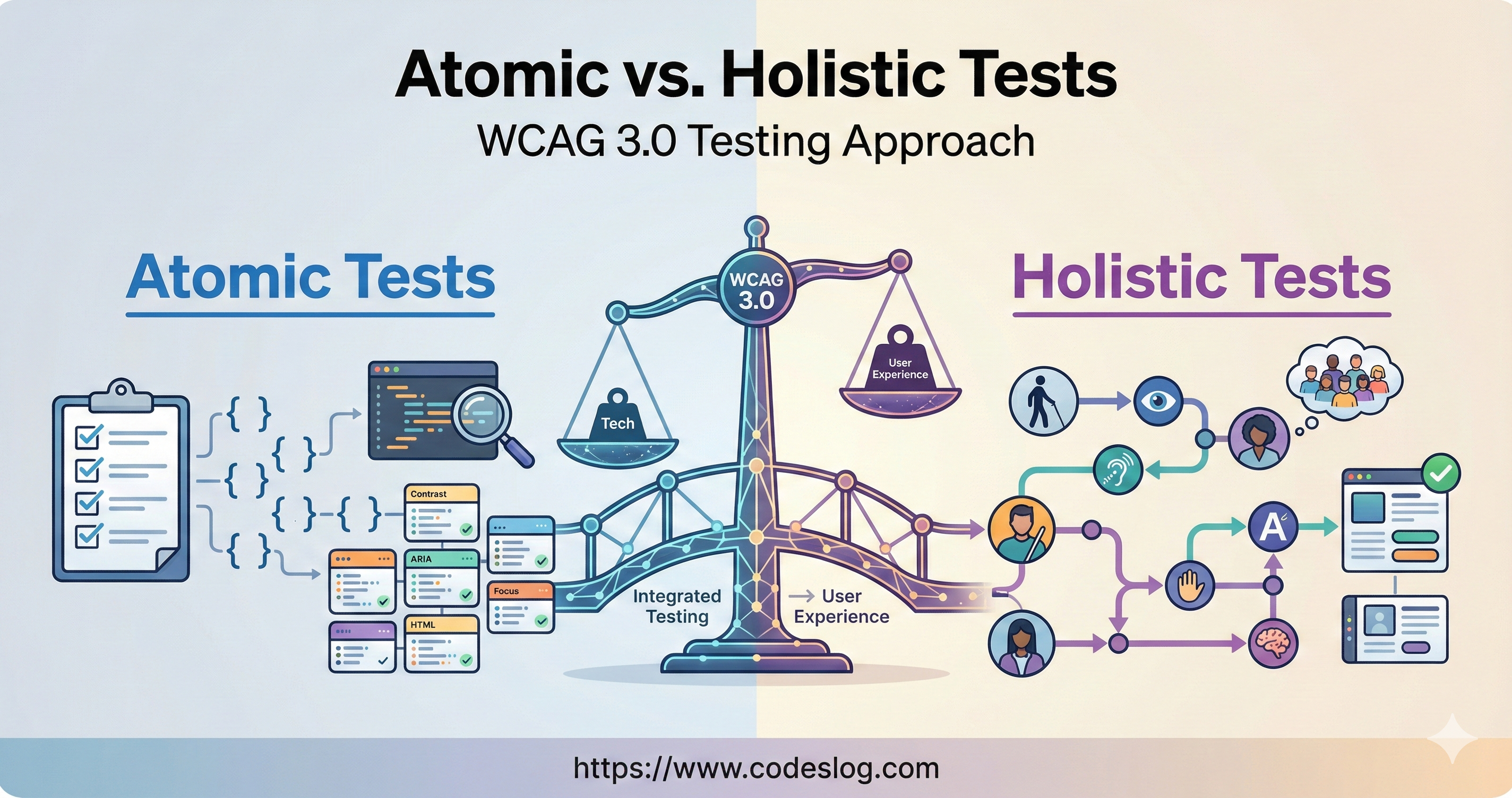
Image: generated with Nanobanana AI
WCAG 2.2 Testing: Success Criteria First#
WCAG 2.2 evaluates Success Criteria. Each criterion is pass/fail, and conformance is only declared if all required levels (A/AA/AAA) are met. The evaluation scope must include a complete set of web pages and complete processes (e.g., login, checkout).
In practice, WCAG 2.2 has these traits:
- Strong for atomic checks: individual elements and rules are testable
- Binary outcomes: a single failure can invalidate a level
- Limited context: real user experience requires additional review
It works well with automation tools, but it struggles to answer the question: “Can a user actually complete the task?”

Photo: Unsplash by Jakub Żerdzicki
WCAG 3.0 Testing Types: Quantitative and Qualitative#
WCAG 3.0 proposes multiple testing types in parallel. The latest Explainer and Draft distinguish Quantitative tests and Qualitative tests.
- Quantitative tests: repeatable criteria with measurable outcomes
- Qualitative tests: user experience, context, and complex interactions
The terms “Atomic Tests” and “Holistic Tests” appeared in the 2021 Working Draft. As a direction, they align with Atomic = quantitative/technical checks and Holistic = user-experience evaluation.
So the goal is not “score everything,” but rather to explain results through a layered mix of tests.
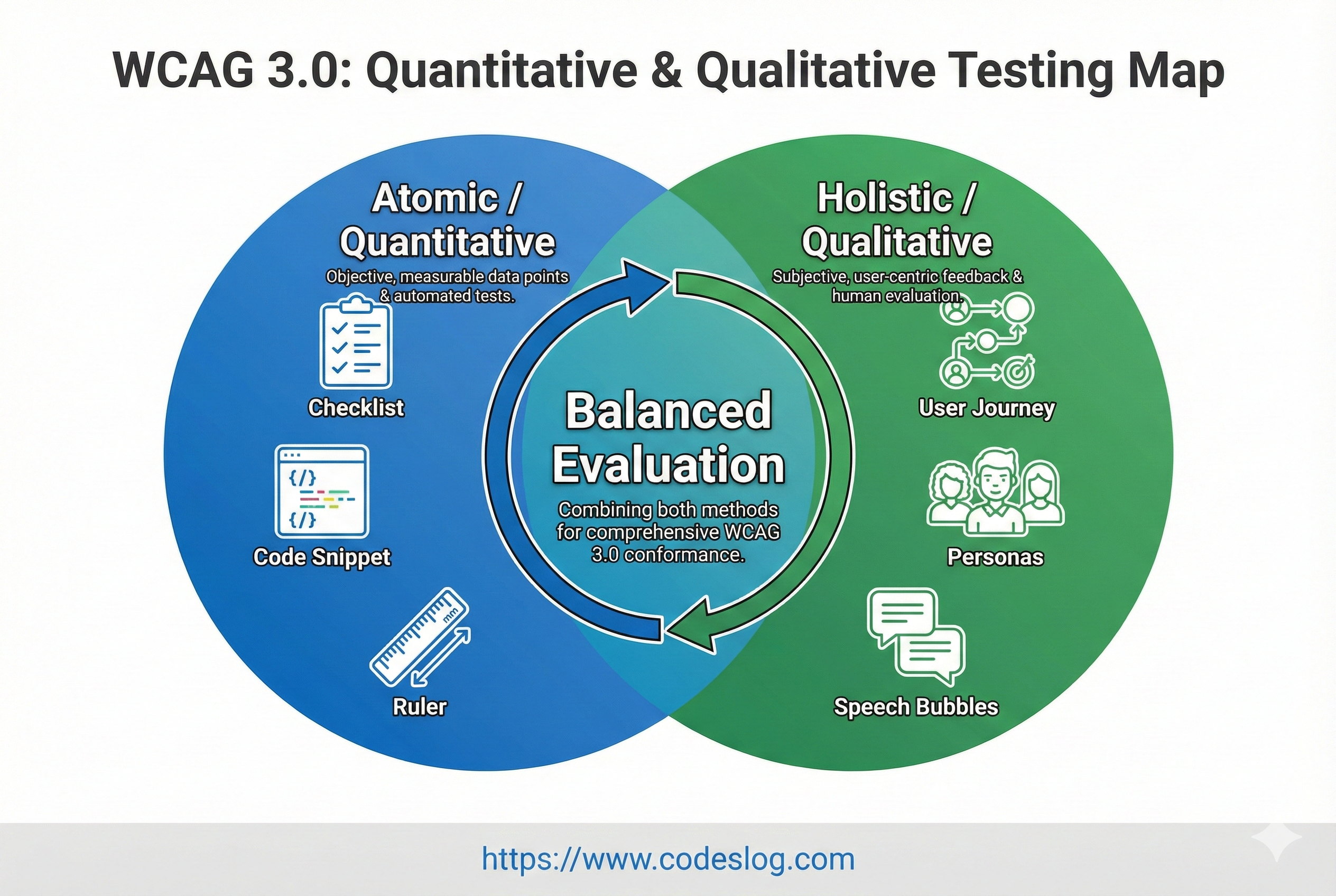
Image: generated with Nanobanana AI
Evaluation Scope in WCAG 3.0: Views and Processes#
WCAG 3.0 scopes evaluation around Views and Processes, rather than pages. This design covers web, apps, documents, and hybrid systems.
- View: a single screen a user sees
- Process: a flow across multiple views
This aligns with testing: Atomic tests verify individual views, while Holistic tests validate end-to-end process quality.
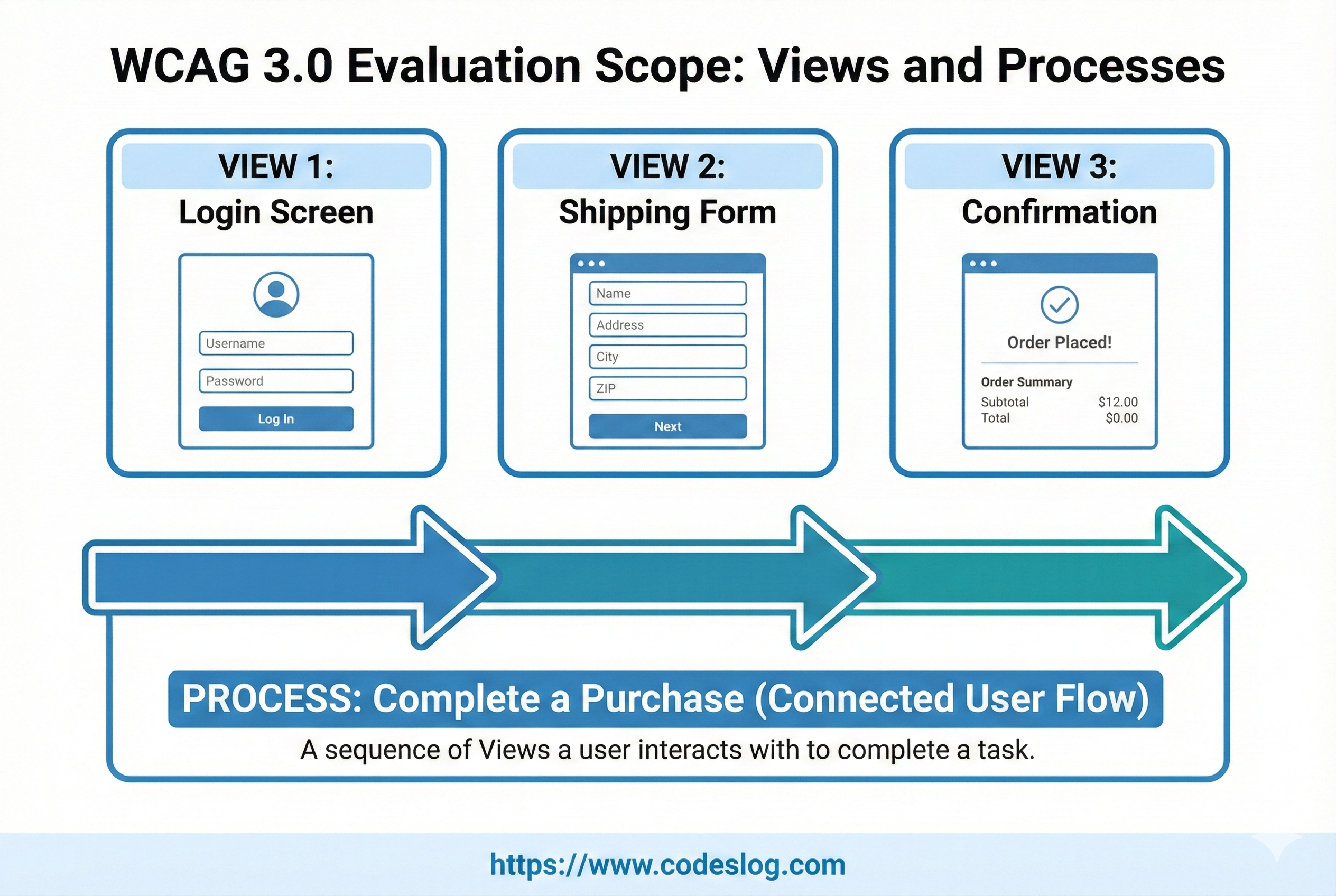
Image: generated with Nanobanana AI
How Tests Shape the Score#
As explained in WCAG 3.0 Conformance Model: Beyond A/AA/AAA, WCAG 3.0 explores a score-based model. The quality of that score depends heavily on what you test.
- Only Atomic tests: fast and consistent, but may miss real usability
- Including Holistic tests: more user-centered, but higher cost and subjectivity
This direction is similar in spirit to Korea’s web accessibility certification process, which separates expert review and user testing. The key difference is that WCAG 3.0 frames the split by test type (quantitative/qualitative) rather than reviewer roles, and it assumes a score-based model.
The core challenge, then, is finding a balanced mix that fits your organization’s resources, product complexity, and user groups.

Photo: Unsplash by Myles Bloomfield
What This Means in Practice#
WCAG 3.0 is not saying “test more.” It’s saying rebalance your testing strategy.
A practical approach looks like this:
Broad Atomic checks
- automated tools + checklists
- wide coverage, fast feedback
Targeted Holistic checks
- user scenario validation
- critical flows (sign-up, checkout, search)
Document outcomes clearly
- not just pass/fail
- “who experienced what, and in which context”
This lets you keep your WCAG 2.2-based audit process while moving toward WCAG 3.0’s direction.

Photo: Unsplash by Christina @ wocintechchat.com M
Closing#
WCAG 2.2 excels at clear rule-based evaluation, while WCAG 3.0 aims to strengthen real-world usability evaluation. The clearest example of that shift is the combination of Atomic and Holistic tests.
In the next post, we’ll look at how Assertions connect to scoring and how Foundational/Supplemental Requirements work together in practice.
Disclaimer: This post is based on the WCAG 3.0 Editor’s Draft (2026-01-05). The specification is still under development, and details may change before it becomes a Recommendation.