Introduction#
This is the seventh post in the WCAG 3.0 series. The expanded scope post looked at how far WCAG 3.0 reaches “beyond the web.” This time, I want to answer a question a lot of people keep asking me.
“Should we migrate to WCAG 3.0?”
Short answer up front: not yet. But there’s an important nuance to that answer. “Conformance” and “improvement” are two different conversations.
Source document: This post is based on the W3C Working Draft of March 3, 2026. Drafts are generally updated on a roughly six-month cycle, so details may have shifted by the time you’re reading this.
Do You Need to Migrate Right Now?#
W3C’s Official Position#
The W3C’s WCAG 3 Introduction document answers this question directly.
“WCAG 3 will not supersede WCAG 2, and WCAG 2 will not be deprecated for at least several years after WCAG 3 is finalized.”
In plain terms: WCAG 3.0 won’t replace WCAG 2.x, and even after WCAG 3.0 is finalized, WCAG 2.x will stay in place for at least several more years.
Where Things Stand Today#
As of July 2026, here’s where WCAG 3(.0) stands:
| Item | Status |
|---|---|
| Document status | W3C Working Draft (2026-03-03) |
| Expected completion | W3C’s own words: “still several years of work remain” |
| Next draft | Roughly every 6 months — likely late 2026 |
| WCAG 2.x deprecation | Won’t be deprecated immediately even once WCAG 3 is finalized |
In other words, there’s no need to migrate for WCAG 3.0 conformance right now.
If your legal requirements, certification standards, or contract terms specify WCAG 2.2 AA (or KWCAG 2.2), keep following those. WCAG 3.0 isn’t an official standard yet, so it carries no legal weight either.
So Why Write This Post?#
If the conclusion is “no migration needed,” you’d think the post could just end here. But there’s an important distinction to draw out.
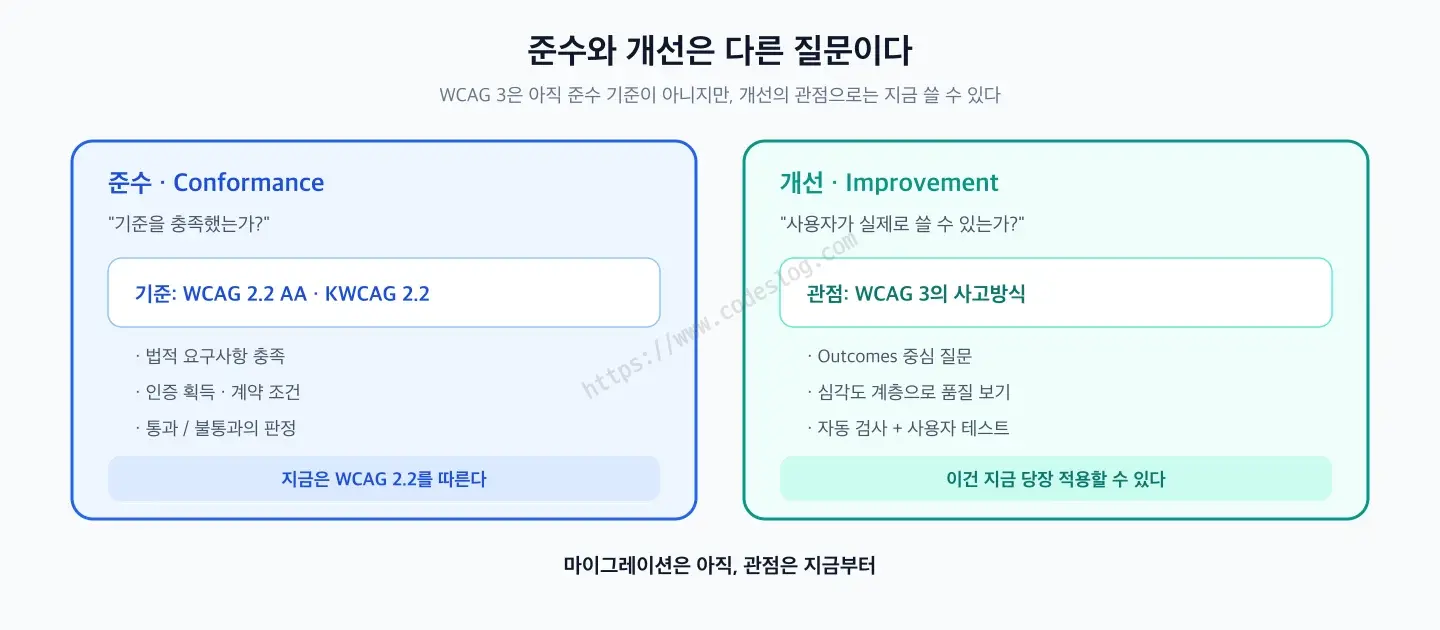
Conformance vs. Improvement#
Conformance is about judging whether a specific standard has been met.
- “Our site conforms to WCAG 2.2 AA”
- Meeting legal requirements
- Earning a certification
Improvement is about substantively making the user experience better.
- “Can users with disabilities actually use our service well?”
- Ongoing quality gains
- Incorporating user feedback
You can’t use WCAG 3.0 as a conformance standard yet. But the direction and mindset WCAG 3.0 is heading toward is something you can put to work for accessibility improvement right now.
That’s the core message of this post. It’s not “conform to WCAG 3.0” — it’s “improve accessibility through WCAG 3.0’s lens.”
Applying WCAG 3.0’s Mindset Today#
Here’s a rundown of the key perspectives worth borrowing from the WCAG 3.0 Draft — all of which work perfectly well in a WCAG 2.x environment.
1. Outcomes-Focused Thinking#
WCAG 2.x’s Success Criteria ask “was this met?” WCAG 3.0’s Outcomes ask “can the user actually do this?” (See the structure post for more detail.)
Example: image alt text
| Perspective | Question | Evaluation method |
|---|---|---|
| Success Criteria | “Does an alt attribute exist?” | Present / absent |
| Outcomes | “Can users understand what the image conveys?” | Quality assessment |
What your team can do right now:
- Instead of focusing on checklist completion, ask “can a person with a disability actually use this feature?”
- Add outcomes-oriented review items to your QA process
2. Tiered Quality Thinking#
WCAG 2.x is a binary — pass or fail. The WCAG 3.0 draft is trying to handle accessibility quality through a Core / Supplemental / Assertions tier structure instead. (The March 2026 draft renamed Foundational to Core.)
| Tier | Meaning |
|---|---|
| Core | Requirements that must be met for baseline conformance |
| Supplemental | Additional requirements for a higher bar |
| Assertions | Extra guarantees an organization can claim for itself |
Note: WCAG 3.0’s conformance model is still experimental and not finalized. See the conformance model post for details.
What your team can do right now:
- Classify accessibility issues by severity level instead of just “present/absent”
- Keep asking “can this be made better?” rather than treating “it passed” as the finish line
- Build a culture that measures and improves accessibility quality continuously
3. User-Centered Testing#
WCAG 3.0 distinguishes between Atomic Tests (automatable technical checks) and Holistic Tests (whole-experience evaluation from a user’s perspective). (See the testing methodology post for more detail.)
What your team can do right now:
- Don’t rely solely on automated tools like axe or Lighthouse
- Set aside time to test with real assistive technology users
- Review the entire user journey through an accessibility lens
4. Considering the Tooling Ecosystem Too#
WCAG 3.0’s scope covers not just content, but CMS platforms, authoring tools, and testing tools as well.
What your team can do right now:
- Build accessibility into your design system as the default, not an add-on
- Factor accessibility support level into how you evaluate CMS or builder tools
- Automate accessibility testing in your CI/CD pipeline
A Gradual Transition Roadmap#
If WCAG 3.0 eventually becomes an official standard, migration will become necessary. Here’s what you can start preparing for now, ahead of that day.
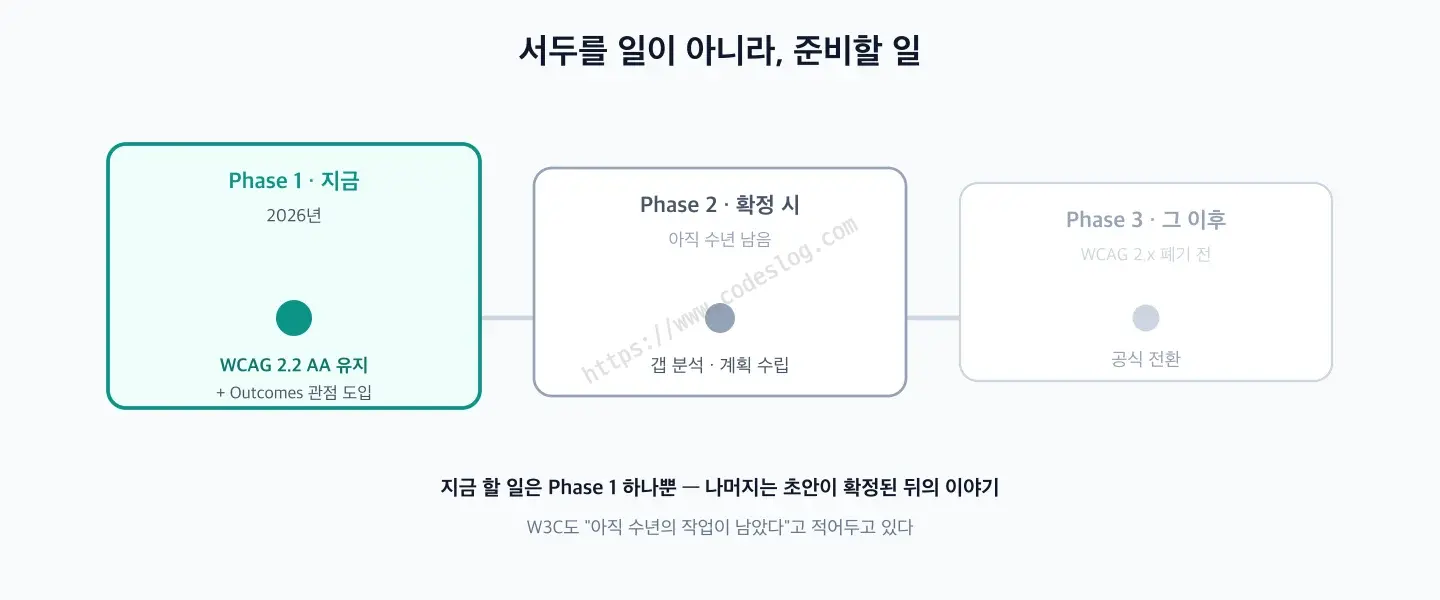
Phase 1: Now (2026)#
Goal: Maintain WCAG 2.2 AA conformance + adopt an improvement mindset
| Activity | Description |
|---|---|
| WCAG 2.2 AA conformance | Meet current legal/contractual requirements |
| Adopt an Outcomes mindset | Ask user-experience questions that go beyond the checklist |
| Monitor the WCAG 3.0 Draft | Check for changes quarterly |
| Team education | Share WCAG 3.0’s direction and core concepts |
Phase 2: Once WCAG 3.0 Is Finalized (around 2029 if the working group schedule holds)#
Goal: Review the official standard and run a gap analysis
| Activity | Description |
|---|---|
| Analyze the final standard | Understand the finalized WCAG 3.0 requirements |
| Gap analysis | Compare your current state against WCAG 3.0 requirements |
| Build a migration plan | Map out needed changes and priorities |
| Update tooling | Update testing tools and audit processes |
Phase 3: Before WCAG 2.x Is Deprecated (expected 2030 and beyond)#
Goal: Complete the formal migration
| Activity | Description |
|---|---|
| Transition to WCAG 3.0 conformance | Meet the new conformance criteria |
| Update documentation | Transition policies, guides, and training materials |
| Renew certifications | Obtain new certifications where required |
A Preparation Guide by Role#
Getting ready for migration looks different depending on your role.
Developers#
- Do now: Prioritize semantic HTML, use ARIA as a supplement
- For WCAG 3.0: Build the habit of baking accessibility into components from the start
- Learn: The Outcomes concept, new testing methodologies
Designers#
- Do now: Color contrast, touch targets, consistent navigation
- For WCAG 3.0: Consider accessibility across the entire user journey
- Learn: Cognitive accessibility, inclusive design principles
PMs/Planners#
- Do now: Spell out accessibility in requirements, build accessibility review into the schedule
- For WCAG 3.0: Set success metrics based on Outcomes
- Learn: WCAG 3.0’s structure and grading system
QA/Testers#
- Do now: Pair automated tools with manual testing
- For WCAG 3.0: Build up Holistic Testing capability
- Learn: Assistive technology usage, user-testing methodology
Quick answers#
Can we get an accessibility audit against WCAG 3.0 right now?
If we already conform well to WCAG 2.2 AA, won't the WCAG 3.0 transition be easy?
What's the one thing our team should do right now?
One-page summary#
- W3C’s official position is clear — WCAG 3.0 will not supersede WCAG 2.x, and WCAG 2.x will remain valid for at least several years even after WCAG 3.0 is finalized.
- The short answer: you don’t need to migrate right now. Legal requirements and certification criteria still point to WCAG 2.2 AA (or KWCAG 2.2).
- The key is separating conformance from improvement — pursue certification against WCAG 2.2, but you can start applying WCAG 3.0’s lens for real quality gains today.
- Four mindsets worth borrowing from WCAG 3.0 now: Outcomes-focused thinking, tiered quality thinking across Core/Supplemental/Assertions, Atomic + Holistic user-centered testing, and considering the tooling ecosystem (CMS, authoring tools).
- The transition follows a three-phase roadmap: Phase 1 (now) maintain WCAG 2.2 and adopt Outcomes thinking → Phase 2 (once the draft is finalized) gap analysis → Phase 3 (before WCAG 2.x is deprecated) formal transition. Right now, only Phase 1 applies.
- Preparation by role: developers build in semantic HTML and accessible components, designers review the full user journey, PMs set Outcomes-based success metrics, and QA builds up Holistic Testing capability.
Wrapping Up#
Here’s the core message on WCAG 3.0 migration, distilled:
You don’t need to migrate right now. WCAG 3.0 is still a Draft, and WCAG 2.x will remain in place for years even after it’s finalized.
But you can apply its direction today. Outcomes-focused thinking, tiered quality evaluation, and user-centered testing all hold up in a WCAG 2.x environment.
Separate conformance from improvement. Follow WCAG 2.2 for certification purposes, but use WCAG 3.0’s lens for substantive quality gains.
Prepare gradually. Monitor the WCAG 3.0 Draft, share new concepts with your team, and update your tools and processes little by little.
I plan to revisit this post as the Draft gets updated. Until then, the four points above should be enough to keep you covered.
Other Posts in This Series#
- The Dawn of WCAG 3.0: Why We Need New Guidelines
- WCAG 3.0 Structure Anatomy: From Success Criteria to Outcomes
- WCAG 3.0 Conformance Model: Moving Beyond A/AA/AAA
- Atomic Tests vs. Holistic Tests: A New Testing Approach
- Assertions: A New Unit for Accessibility Evaluation
- WCAG 3.0 Expanded Scope: Beyond the Web
- WCAG 3 Status Check: A Complete Rundown of the March 2026 Draft
References#
- WCAG 3.0 Working Draft (2026-03-03) - Official W3C draft
- WCAG 3 Introduction - Overview document
- WCAG 2.2 - Current recommendation
- Understanding WCAG 2.2 - WCAG 2.2 understanding document
Disclaimer: This post is based on the W3C Working Draft dated March 3, 2026. WCAG 3.0 is still under development, and its content may change before the final recommendation is published. Please refer to the original W3C documents when you need to make an actual decision.
Leave a comment