Introduction#
In the previous post, we looked at why WCAG 3.0 reorganized “Success Criteria” into “Outcomes.”
This post focuses on changes to the conformance model. WCAG 3.0 aims for a different approach than WCAG 2.x, but it is still in the Editor’s Draft (2026-01-05) stage and is not finalized. Conformance levels, scoring approaches, and evaluation methods are still being explored.
Important: This post is based on the WCAG 3.0 Editor’s Draft (2026-01-05). The draft can change at any time, and the document itself is explicitly marked as a work in progress.
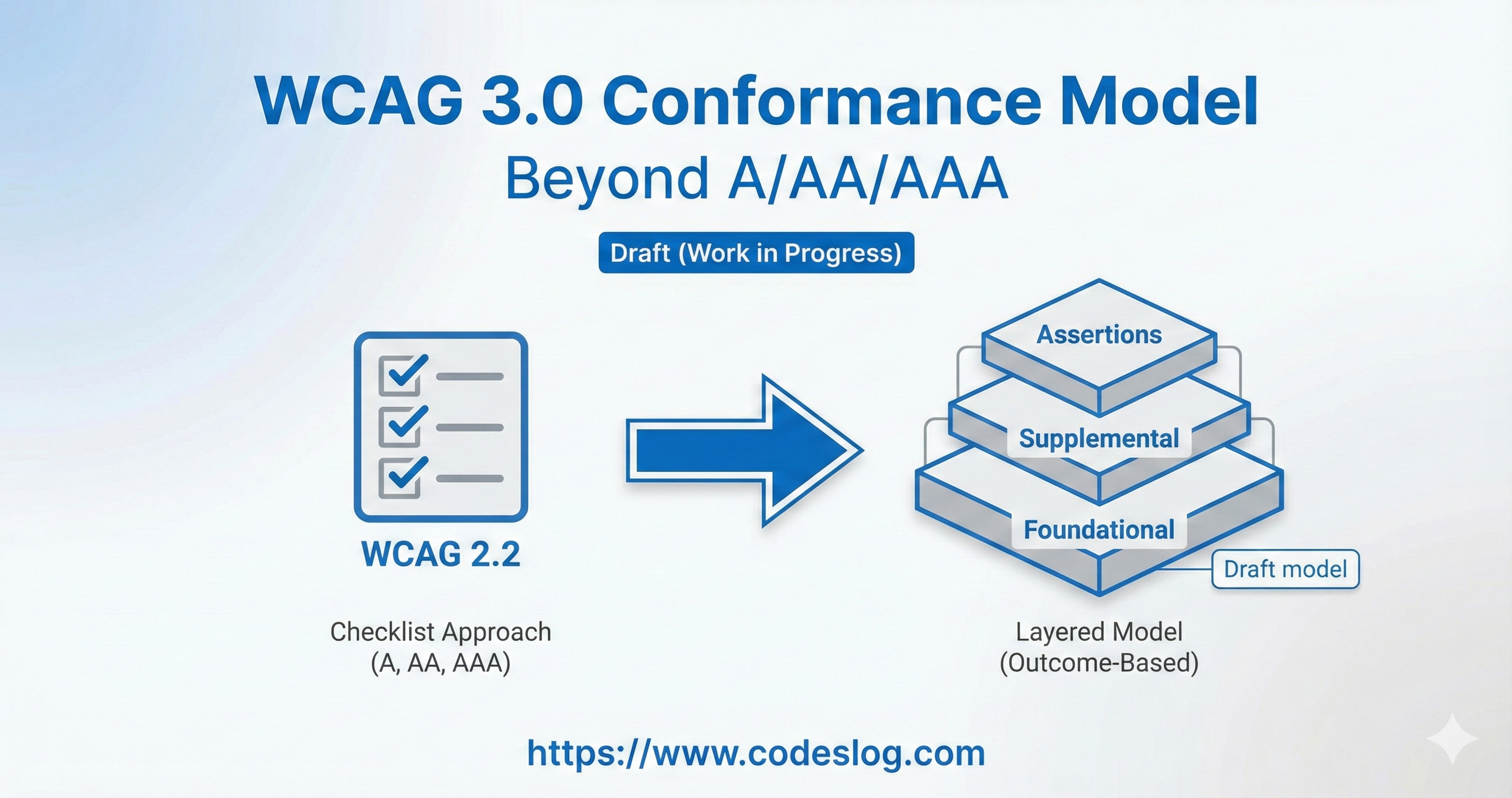
Image: Generated with Nanobanana AI

Photo: Unsplash by Anna Evans
WCAG 2.2 Conformance Model: All or Nothing#
A, AA, AAA Levels#
WCAG 2.2 evaluates each Success Criterion as Pass or Fail. Conformance levels are defined as:
- Level A: Minimum level. All Level A Success Criteria (30 items) must be met. Without this level, some users cannot access the content at all.
- Level AA: Recommended level. All Level A + Level AA Success Criteria (50 total) must be met. This is the level required by most laws and policies.
- Level AAA: Highest level. All Success Criteria (86 total) must be met. Not recommended as a site-wide goal because it is difficult to apply to all types of content.
All-or-Nothing Model#
WCAG 2.2 requires all Success Criteria at a level to pass in order to claim that level of conformance. If any criterion fails, you cannot claim that level.
WCAG 2.2 also defines conformance at the full-page level. You cannot claim conformance for only part of a page (for example, a single section).

Photo: Unsplash by John M. Smit
WCAG 2.2 Conformance claim summary#
Conformance claims are optional, but if you choose to make one, WCAG 2.2 expects the following information:
- claimed conformance level (A/AA/AAA)
- standard name and version
- scope of the claim (which pages/URLs are included)
- technologies relied on (for example, HTML, CSS, JavaScript)
WCAG 3.0 Conformance Model: Key Directions in the Draft#
The WCAG 3.0 Editor’s Draft makes one point clear: the conformance model is still being tested and refined. These are the directions explicitly described in the current draft.
1) Foundational / Supplemental / Assertions#
- Foundational Requirements: required for a baseline level of conformance
- Supplemental Requirements: additional requirements for higher levels
- Assertions: optional statements an organization can claim beyond required outcomes
The draft states that the baseline level must meet all Foundational Requirements, and that this baseline is somewhat comparable to WCAG 2.2 Level AA.
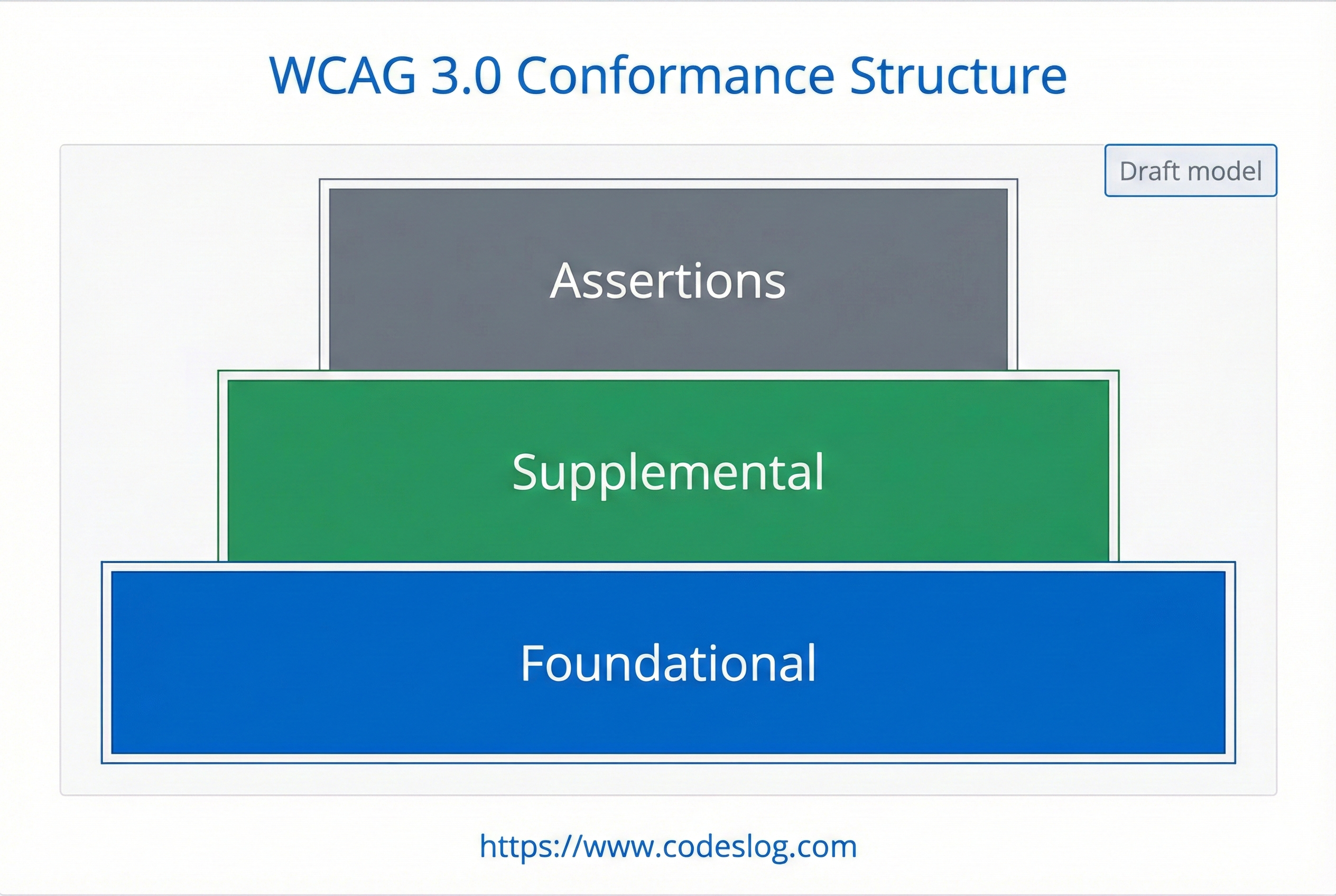
Image: Generated with Nanobanana AI
2) Exploring multiple scoring models#
WCAG 3.0 is exploring points, percentages, and requirement sets (modules). It is also considering ideas such as conformance levels, issue severity, adjectival ratings, and pre-assessment checks.
In short, there is no fixed scoring scale or threshold yet.
3) Conformance scope: Views and Processes#
WCAG 3.0 defines conformance scope by views and processes.
- Conformance is determined for one or more complete views or processes
- All unique steps in a process must be included
- Conformance claims are optional, and must follow the specified format when provided
This is one of the biggest differences from WCAG 2.2’s page-based scope.
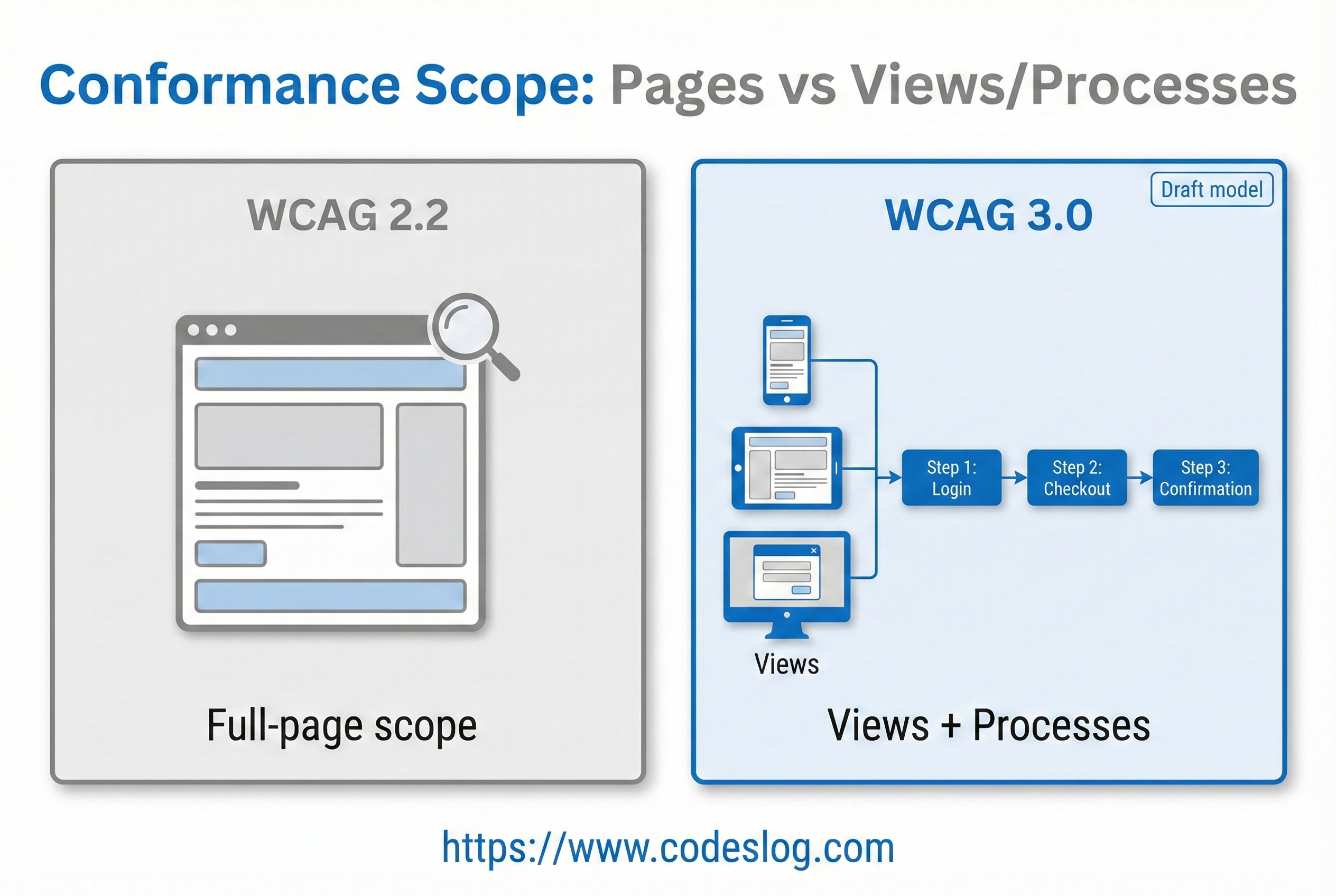
Image: Generated with Nanobanana AI
4) Conformance claims are optional#
The WCAG 3.0 Draft explicitly states that a conformance claim is not required. If you do provide one, it must include required details such as scope (views/processes), technologies, and evaluation date.
5) Documenting Assertions#
Assertions are optional, but the Draft expects them to be documented with evidence (for example, scope, rationale, and date). They are not meant to be informal statements.
WCAG 2.2 AA vs WCAG 3.0 Foundational#
Similarities and differences#
The draft says Foundational is somewhat similar to WCAG 2.2 AA, but the structure and evaluation unit differ.
| Item | WCAG 2.2 AA | WCAG 3.0 Foundational (Draft) |
|---|---|---|
| Evaluation basis | Success Criteria (SC) | Foundational Requirements |
| Scope unit | Full pages | Views / processes |
| Conformance rule | All SC in the level must pass | All Foundational requirements must pass |
| Stability | Recommendation | Editor’s Draft (experimental) |
Key takeaways#
- WCAG 2.2 is page-based and pass/fail
- WCAG 3.0 Draft proposes view/process scope and Foundational-based evaluation
So WCAG 2.2 AA compliance is a strong starting point, but re-evaluation is required because the scope and structure are different.
Practical preparation#

Photo: Unsplash by Lindsay Henwood
1) Maintain WCAG 2.2 compliance#
Most regulations still reference WCAG 2.2. Keep that baseline in place.
2) Pilot WCAG 3.0 Draft checks#
- Review Foundational requirements against your current backlog
- Identify outcomes not covered by existing WCAG 2.2 audits
3) Practice scope definition#
WCAG 3.0 requires scope definition using views and processes. Map your critical user journeys and ensure all unique steps are included.
4) Build internal evaluation habits#
Even before scoring is finalized, track Foundational compliance and document gaps consistently.
FAQ#
Q1. Is the WCAG 3.0 conformance model finalized?#
No. The Editor’s Draft is still a work in progress, and the conformance model is explicitly under exploration.
Q2. If I meet WCAG 2.2 AA, do I meet WCAG 3.0 Foundational?#
Not automatically. The draft says Foundational is somewhat comparable to WCAG 2.2 AA, but the scope (views/processes) and structure require re-assessment.
Q3. What scoring system will WCAG 3.0 use?#
The draft explores points, percentages, requirement sets, and related concepts (conformance levels, issue severity, adjectival ratings). There is no fixed scoring scale or thresholds yet.
Q4. How is conformance scope defined?#
Conformance is defined for views and processes. A process must include all unique steps, and additional views can be included as needed.
Q5. Are conformance claims required?#
No. Conformance claims are optional, but if you choose to make one, the draft specifies required information.
Closing#
WCAG 3.0 is still a draft, but the direction is clear: a model built around Foundational/Supplemental/Assertions and view/process scope. At the same time, scoring and conformance levels are still being explored, so there is no official scoring formula yet.
For now, maintain WCAG 2.2 compliance and start mapping your systems to the draft’s structure. That preparation will make the eventual transition smoother.
The next post will cover WCAG 3.0 evaluation methods in more detail.
References#
Disclaimer: This post is based on the WCAG 3.0 Editor’s Draft (2026-01-05). The specification is still under development, and details may change before it becomes a Recommendation.