Introduction#
In the previous post, we looked at why WCAG 3.0 reorganized “Success Criteria” into “Outcomes.”
This post focuses on changes to the conformance model. WCAG 3 aims for a different approach than WCAG 2.x, but it is still at the Working Draft (2026-03-03) stage and the model is not finalized. In particular, the thresholds for conformance levels are still marked “to be determined” in the draft text.
Basis document: This post is based on the W3C Working Draft of March 3, 2026. One thing worth noting: within the draft itself, the Conformance chapter is marked
Exploratory, the least mature maturity stage (the Guidelines chapter is markedDeveloping). That means this is the part of the post most likely to shift again.
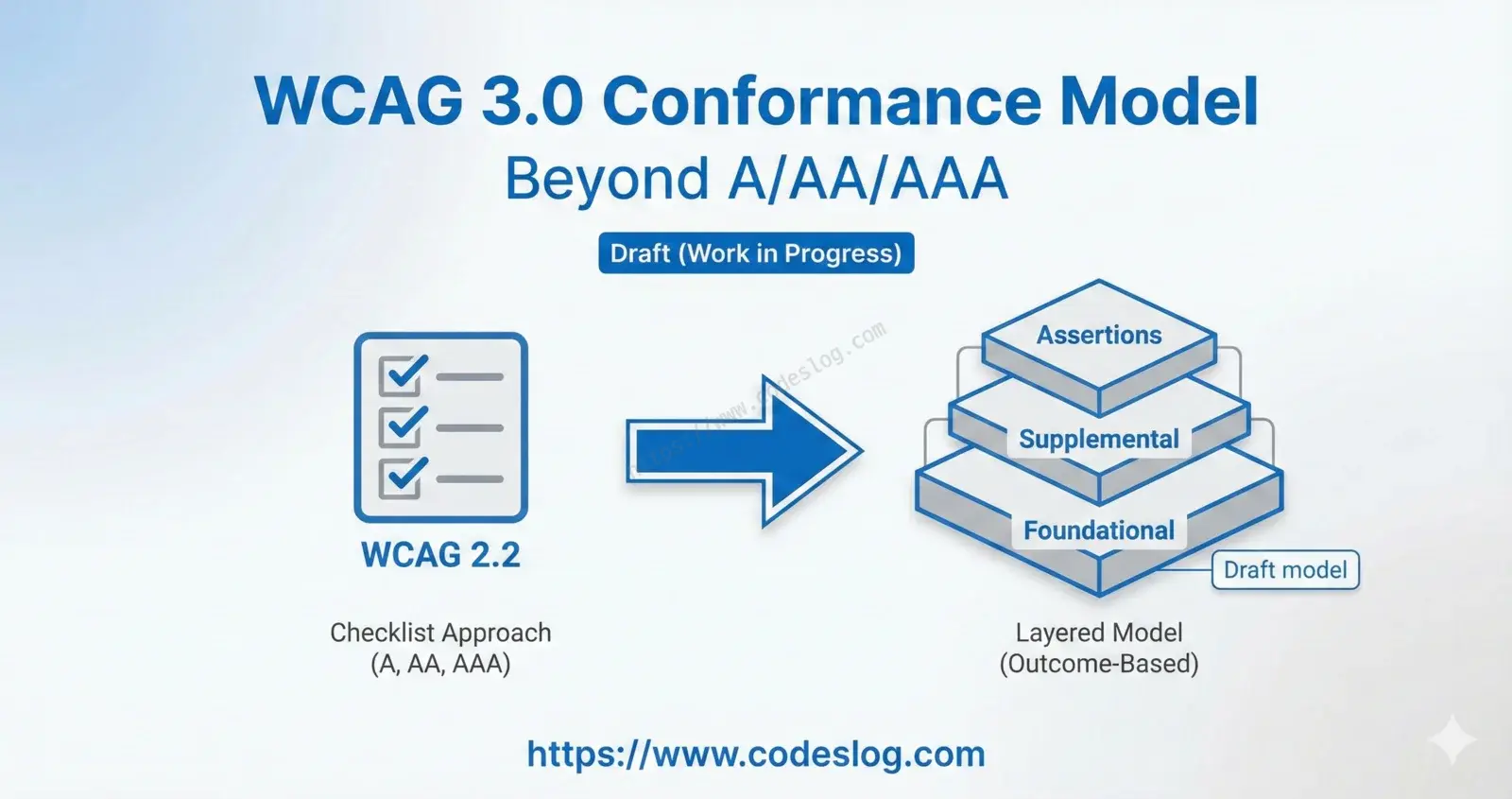
Image: Generated with Nanobanana AI

Photo: Unsplash by Anna Evans
WCAG 2.2 Conformance Model: All or Nothing#
A, AA, AAA Levels#
WCAG 2.2 evaluates each Success Criterion as Pass or Fail. Conformance levels are defined as:
- Level A: Minimum level. All Level A Success Criteria (30 items) must be met. Without this level, some users cannot access the content at all.
- Level AA: Recommended level. All Level A + Level AA Success Criteria (50 total) must be met. This is the level required by most laws and policies.
- Level AAA: Highest level. All Success Criteria (86 total) must be met. Not recommended as a site-wide goal because it is difficult to apply to all types of content.
All-or-Nothing Model#
WCAG 2.2 requires all Success Criteria at a level to pass in order to claim that level of conformance. If any criterion fails, you cannot claim that level.
WCAG 2.2 also defines conformance at the full-page level. You cannot claim conformance for only part of a page (for example, a single section).

Photo: Unsplash by John M. Smit
WCAG 2.2 Conformance claim summary#
Conformance claims are optional, but if you choose to make one, WCAG 2.2 expects the following information:
- claimed conformance level (A/AA/AAA)
- standard name and version
- scope of the claim (which pages/URLs are included)
- technologies relied on (for example, HTML, CSS, JavaScript)
WCAG 3.0 Conformance Model: Key Directions in the Draft#
The core message of the WCAG 3.0 Editor’s Draft process has been “testing multiple approaches before locking in a model.” Here are the directions the current draft makes explicit.
1) Core / Supplemental / Assertions#
- Core Requirements: must be met at the baseline conformance level (92 items)
- Supplemental Requirements: additional requirements for higher levels (61 items)
- Assertions: procedural guarantees an organization documents and claims itself (28 items)
- Best practices: a new category in the March draft. Not meeting these has no effect on conformance
The name changed. Foundational, used through the September 2025 draft, was replaced by Core in the March draft (
Foundationalno longer appears anywhere in the document). Be careful when consulting older material.
The Explainer document describes Core Requirements as covering a scope that is “similar to, but not identical to,” WCAG 2.2 Level AA.
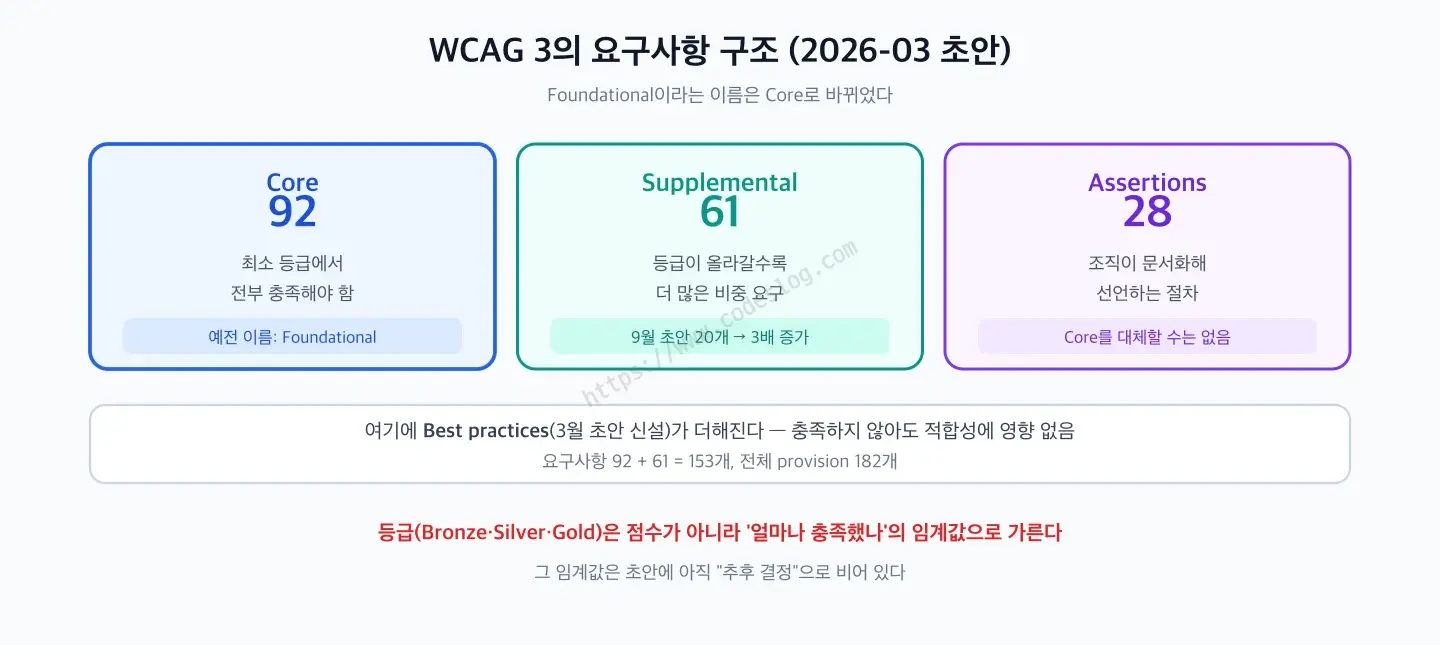
Image: Generated with Nanobanana AI
2) Bronze / Silver / Gold — Back, But Not a Points System#
This is the biggest change in this post. The Bronze/Silver/Gold levels, present in the first 2021 draft and then dropped, are back in the March draft.
- Bronze (minimum level): every view/process in scope meets all Core Requirements, plus some portion of Supplemental and Assertions
- Silver: a larger portion of Supplemental/Assertions than Bronze
- Gold: a larger portion than Silver
Two things here are easy to misread, though.
First, this is not a points-based system. The old Silver-era machinery — 0-4 point scoring, weighted averages, critical errors zeroing out a score — is not in the March draft text. It’s a threshold-based approach that looks at how much of a requirement set has been met. You’ll see claims floating around that “WCAG 3 introduces a flexible scoring system,” but that doesn’t match the current draft.
Second, that “some portion” hasn’t been pinned down as a number yet. The draft literally says “some portion (to be determined).”
2-1) Levels are judged per functional performance statement#
This is a less-known but important change. Rather than assigning one level to a site as a whole, levels are judged per functional performance statement. That means conformance can differ across different user needs — visual, auditory, cognitive, and so on — so a state like “Silver overall, but Bronze for a specific need” is possible.
3) Conformance scope: Views and Processes#
WCAG 3.0 defines conformance scope by views and processes.
- Conformance is determined for one or more complete views or processes
- All unique steps in a process must be included
- Conformance claims are optional, and must follow the specified format when provided
This is one of the biggest differences from WCAG 2.2’s page-based scope.
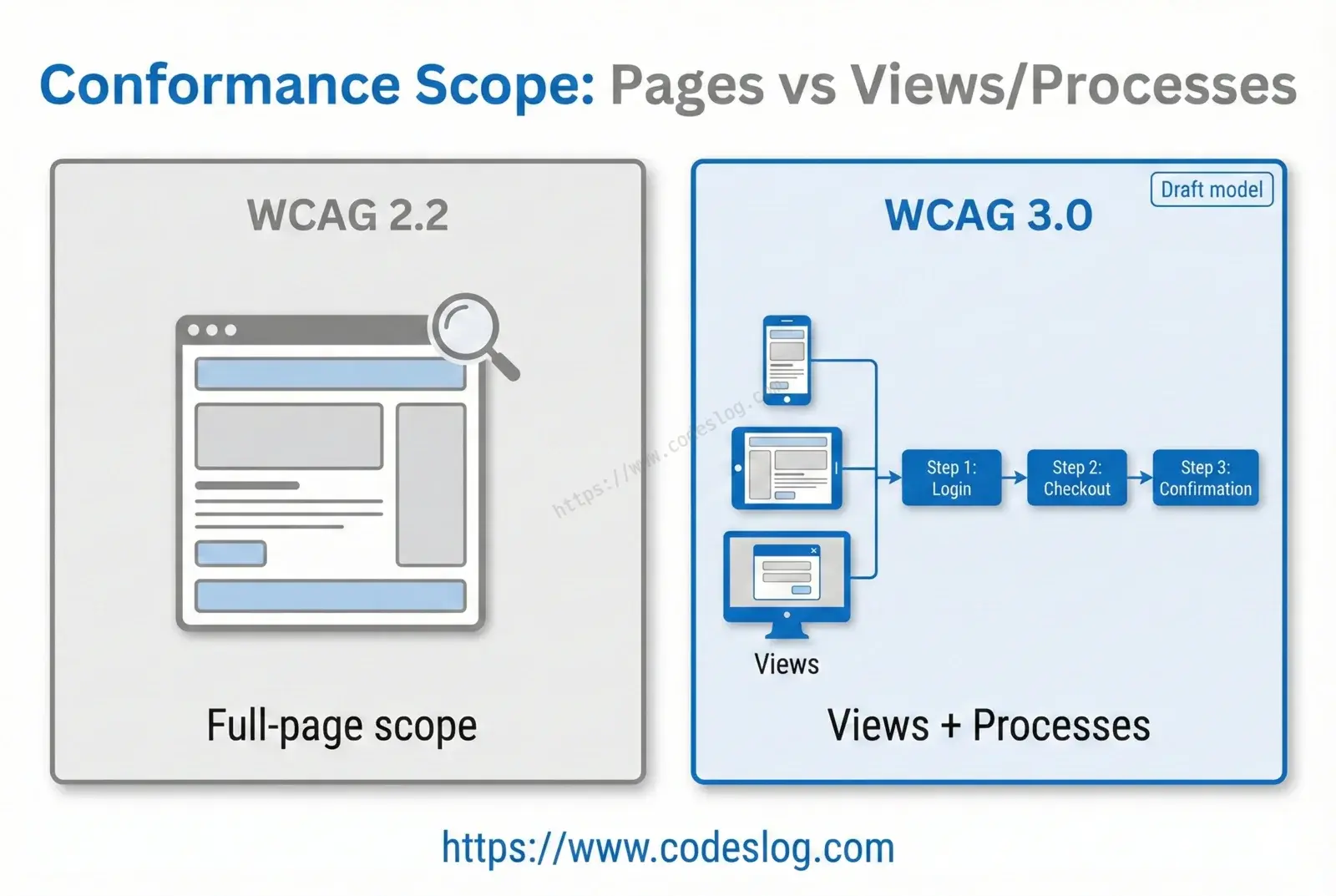
Image: Generated with Nanobanana AI
4) Conformance claims are optional#
The WCAG 3.0 Draft explicitly states that a conformance claim is not required. If you do provide one, it must include required details such as scope (views/processes), technologies, and evaluation date.
5) Documenting Assertions#
Assertions are optional, but the Draft expects them to be documented with evidence (for example, scope, rationale, and date). They are not meant to be informal statements.
WCAG 2.2 AA vs WCAG 3 Core#
Similarities and differences#
The Explainer describes Core as “similar to, but not identical to,” WCAG 2.2 AA. The structure and evaluation unit differ.
| Item | WCAG 2.2 AA | WCAG 3 Core (2026-03 draft) |
|---|---|---|
| Evaluation basis | Success Criteria (SC) | Core Requirements (92 items) |
| Scope unit | Full pages | Views / processes |
| Conformance rule | All SC in the level must pass | All Core requirements + some portion of Supplemental/Assertions |
| Levels | A / AA / AAA | Bronze / Silver / Gold (thresholds undefined) |
| Judged per | Whole site/page | Functional performance statement |
| Stability | Recommendation | Working Draft, Conformance chapter Exploratory |
Key takeaways#
- WCAG 2.2 is page-based and pass/fail
- The WCAG 3 draft proposes view/process scope and Core-based evaluation
So WCAG 2.2 AA compliance is a strong starting point, but re-evaluation is required because the scope and structure are different.
Practical preparation#

Photo: Unsplash by Lindsay Henwood
1) Maintain WCAG 2.2 compliance#
Most regulations still reference WCAG 2.2. Keep that baseline in place.
2) Pilot WCAG 3.0 Draft checks#
- Review Core requirements against your current backlog
- Identify outcomes not covered by existing WCAG 2.2 audits
3) Practice scope definition#
WCAG 3.0 requires scope definition using views and processes. Map your critical user journeys and ensure all unique steps are included.
4) Build internal evaluation habits#
Even before the thresholds are finalized, track Core requirement compliance and keep a log of gaps — that groundwork will carry over directly once the thresholds land.
Quick answers#
Is the WCAG 3.0 conformance model finalized?
If I meet WCAG 2.2 AA, do I meet WCAG 3 Core?
What scoring system or levels will WCAG 3.0 use?
How is conformance scope defined?
Are conformance claims required?
One-page summary#
- Core/Supplemental/Assertions structure — all 92 Core requirements must be met; only a portion of the 61 Supplemental and 28 Assertions items are required, depending on level.
Foundationalwas renamed Core in the March draft. - Bronze/Silver/Gold are back in the March draft, but it’s not a points system — the old 0-4 point scoring and weighted averages are gone; it’s a threshold-based approach measured against how much of a requirement set is met.
- Each level’s threshold (“some portion”) is still not a defined number — marked “to be determined.”
- Levels are judged per functional performance statement, not once for the whole site.
- Conformance scope is defined by views/processes, not by page.
- The Conformance chapter is at the
Exploratorystage — less mature than the Guidelines chapter (Developing), so this is the part of the draft most likely to still change. - Core is “similar to, but not identical to” WCAG 2.2 AA — AA compliance is a good starting point, but re-evaluation is required.
Closing#
WCAG 3 is still a draft, but the direction toward a Core/Supplemental/Assertions conformance model is clear. The Bronze/Silver/Gold level names are back too. That said, the threshold for each level is still empty, and the Conformance chapter is one of the least mature parts of the draft.
In practice, the realistic strategy is to maintain WCAG 2.2 compliance while preparing around WCAG 3’s scope definition (views/processes) and Core requirements.
I’ll revise this post again as the draft updates. The next draft is expected in Q4 2026.
Other Posts in This Series#
- The Dawn of WCAG 3.0: Why We Need New Guidelines
- WCAG 3.0 Structure Anatomy: From Success Criteria to Outcomes
- Atomic Tests vs. Holistic Tests: A New Testing Approach
- Assertions: A New Unit for Accessibility Evaluation
- WCAG 3.0 Expanded Scope: Beyond the Web
- WCAG 3 Migration: Do You Need It Yet? Moving On from WCAG 2.2
- WCAG 3 Status Check: A Complete Rundown of the March 2026 Draft
References#
- W3C Accessibility Guidelines (WCAG) 3.0 Working Draft (2026-03-03)
- WCAG 3.0 Explainer
- WCAG 2.2 Guidelines
Note: This post is based on the W3C Working Draft of March 3, 2026. WCAG 3 is still under development, so details may change before a final Recommendation, and the conformance model in particular is at the least mature stage within the draft. Check the original W3C document when you need an authoritative answer.