What happens when you run one million home pages through an automated accessibility checker?
About 56 million accessibility errors come pouring out. That’s an average of 56.1 per page.
The number alone might get a shrug: “that’s just the web.” The problem is the direction. Last year it was 51. In a single year, errors grew by 10.1%. After years of slow-but-steady progress, web accessibility just took a step backward.
What grew, and why? The WebAIM Million report, built on February 2026 data and released that March, has the details.
What Is the WebAIM Million, Anyway?#
WebAIM (Web Accessibility In Mind) is a web accessibility organization based at Utah State University, also known as the maker of the WAVE testing tool. Since 2019, WebAIM has run an annual automated analysis of the home pages of the top one million websites using the WAVE engine. That’s the WebAIM Million report.
Two things to keep in mind before reading:
- It measures automated checks only. It counts errors a machine can reliably detect: missing alt text, insufficient contrast, unlabeled form fields, and so on. Problems you only find by actually using a page, like keyboard traps or illogical focus order, aren’t included.
- Which means these numbers are flattering. Passing an automated scan doesn’t make a page accessible. Treat this as a floor, not a ceiling.
Keep that in mind: the floor is 56 errors per page. Now, this year’s report card.
This Year’s Report Card: The Trend Reversed#
The headline numbers:
- 95.9% of home pages had detectable WCAG 2 failures (94.8% last year)
- 56.1 errors per page on average (51 last year, +10.1%)
- 1,437 elements per page on average (+14.3% in a single year)
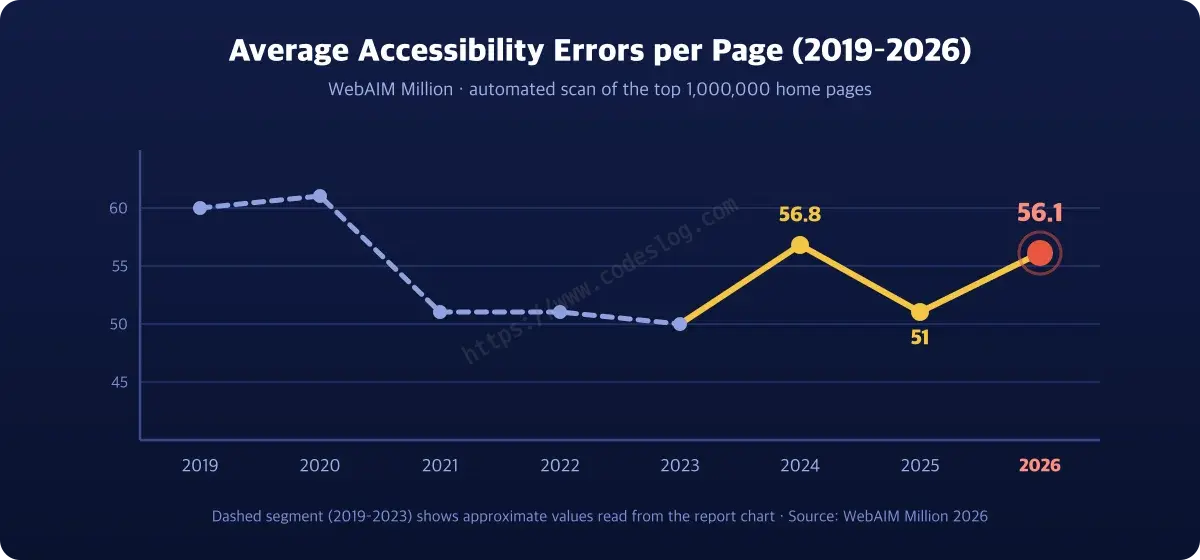
Looking at the trend, average errors had settled around 50 since 2021. There was a spike in 2024, a return to 51 in 2025, and now a climb back to 56.1.
Error density tells a slightly different story. Errors as a share of all page elements sit at 3.9%. Individual elements didn’t suddenly get worse; pages got much heavier, so the absolute error count grew with them. A single home page now carries nearly twice as many elements as it did seven years ago (782 in 2019).
It reads as a sign that quality control isn’t keeping pace with how fast the web is getting more complex. That is probably not an accessibility problem alone.
The Culprits Are the Same Six, Every Year#
This report has a tradition that would be funny if it weren’t sad: the top of the error list barely changes. This year, six error types accounted for 96% of all detected errors.
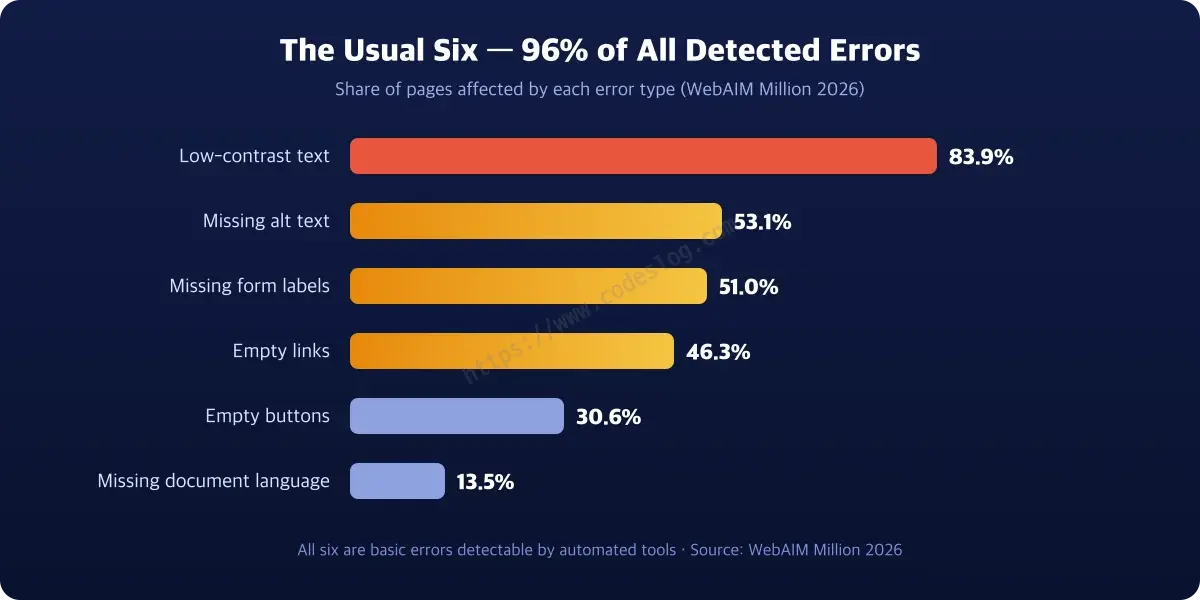
| Error type | Pages affected |
|---|---|
| Low-contrast text | 83.9% |
| Missing image alt text | 53.1% |
| Missing form labels | 51.0% |
| Empty links | 46.3% |
| Empty buttons | 30.6% |
| Missing document language (lang) | 13.5% |
Every one of these is first-semester web development material. These aren’t errors caused by a lack of advanced technology.
- Low-contrast text → one pass with a contrast checker at the design stage catches it.
- Missing alt → it’s one line:
<img alt="...">. The million pages contained 66.6 million images, and 16.2% had no alt text. Worse, 45% of those alt-less images were used as links, so a screen reader user has no way of knowing where that link goes. - Missing form labels → a
<label for="...">association. Pages now average 6.9 form inputs (up 36% in three years), and 33.1% of them sit there unlabeled. - Empty links and buttons → usually an icon with no accessible name.
- Missing lang →
<html lang="en">. Genuinely, one word.
The easiest questions are the ones most people get wrong, like fumbling question #1 on a big exam. Not from lack of skill, but because nobody looked.
The ARIA Paradox: More ARIA, More Errors?#
This is the part of the report with the most to talk about.
ARIA (Accessible Rich Internet Applications) is a set of attributes for conveying role and state information to assistive technology when HTML alone can’t express it. Used well, it makes complex widgets accessible. It’s genuinely a good tool.
But the statistics paint a curious picture.
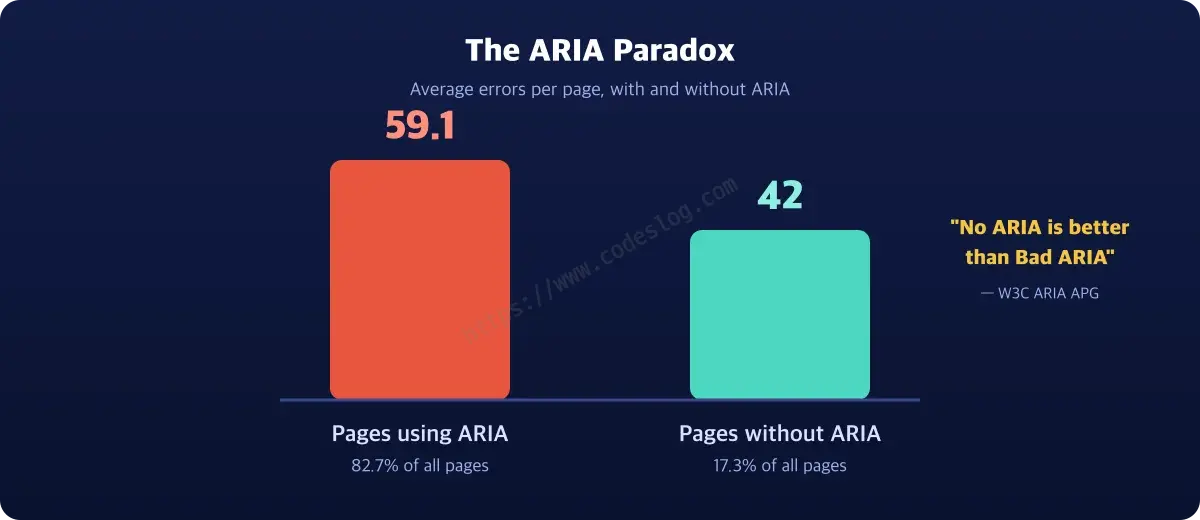
- 82.7% of home pages use ARIA, averaging 133 attributes per page (+27% in one year)
- Pages with ARIA: 59.1 errors on average
- Pages without ARIA: 42 errors on average
Pages using ARIA have more errors. This is correlation, of course. Complex pages use more ARIA and have more errors to begin with. But there’s a reason the W3C’s own documentation carries this official warning:
No ARIA is better than Bad ARIA.
ARIA is like pepper. Applied in the right places, it elevates the dish. Dump the whole jar in because you’re worried about accessibility, and that’s not cooking. The moment you add role="button", you own the keyboard event handling too. Misplace an aria-hidden="true" and perfectly good content vanishes from screen readers entirely. Speaking of which: aria-hidden="true" now averages 23.3 instances per page, up 30% in one year.
The fundamentals haven’t changed. If semantic HTML can express it, use HTML. ARIA comes second.
Why the Regression, and Why Now?#
The report points to two broad currents.
First, pages are getting complex fast. Elements +14.3%, ARIA +27%, headings +20.4%, all in a single year. As third-party frameworks, components, and widgets pile up, a growing share of markup is code developers don’t directly control.
Second, AI-assisted coding. The report’s conclusion names it directly, alongside reliance on third-party frameworks: automated or AI-assisted coding practices, or “vibe coding.” Markup is being produced faster than accessibility review can keep up. The accessibility problems in AI-generated markup have been flagged for a while; now they are starting to show up in the statistics.
WebAIM’s Christopher Phillips diagnosed the result as a cultural problem as much as a technical one: barriers persist because their impact on disabled users remains too easy for organizations to overlook. The line he invoked sticks with you:
“Every system is perfectly designed to get the results it gets.”
A system whose accessibility regressed is a system designed to let accessibility regress. Feel that one land?
How Korea Compares#
You might hope things look better closer to home. If home is South Korea, unfortunately, not really.
Korea’s national web accessibility survey for 2025, published in March 2026, found an alt text compliance rate of just 17.1%. The methodologies differ (Korea’s survey measures per-criterion compliance; WebAIM measures error detection), so a direct comparison is shaky. But one conclusion matches exactly: the most basic items are the most broken, at home and abroad. I analyzed the Korean survey in this post.
That the whole world shares this problem isn’t much consolation. The better way to read it: just getting the basics right puts you ahead of the pack.
What We Can Do Tomorrow#
The paradoxical good news in this report: 96% of the errors fall into six basic types, and automated tools catch every one of them. If they can be detected, they can be prevented.
① Wire automated checks into CI
Put axe-core, Lighthouse CI, or pa11y into your build pipeline, and most of the usual six get caught before deployment. Don’t rely on human goodwill. Let the system do the catching.
② Validate contrast at the design stage
Low-contrast text, the one affecting 83.9% of pages, is a design-token problem, not a code problem. Lock in contrast ratios (4.5:1 for body text) when you define the color palette, and every page downstream inherits the fix.
③ Treat accessibility review of AI-generated markup as a default
Don’t merge AI-generated components as-is. <div onclick> buttons, odd alt text on decorative images, and scattershot ARIA are regulars in AI output.
④ Fix existing errors before writing new code
Most of those 56 errors per page weren’t created today. They’ve been sitting there. One sprint spent clearing the usual six makes a bigger difference to users than most new features.
Wrapping Up#
For the seventh year running, the conclusion writes itself: the biggest barrier to web accessibility isn’t hard technology. It’s basics left undone.
But this year adds a warning light. As the web grows more complex and code generation gets faster, the interest rate on “we’ll get to it later” keeps climbing. Fifty-six million errors might just be the invoice.
Tomorrow at work, try running your page through WAVE or axe. If you come in under the average (56.1), congratulations: you’re already beating the world. Now walk it down toward zero, one fix at a time.
References#
- The WebAIM Million — The 2026 report on the accessibility of the top 1,000,000 home pages (WebAIM)
- Tolerating Inaccessibility (WebAIM Blog, Christopher Phillips)
- The WebAIM Million Report 2026: what it tells us (Nexer Digital)
- Read Me First — No ARIA is better than Bad ARIA (W3C ARIA Authoring Practices Guide)
Leave a comment